

I have a pair of baggy Calvin Klein jeans that I absolutely love. I bought them at a store in Lexington, Kentucky, when visiting my sister, and started wearing them on the same trip. They’re great. I was a bit nervous, as it was my first time buying baggy jeans, but they’ve grown on me. I like the look and feel.
One thing though, if I were to put my nitpick hat on (and this isn’t specific to these jeans, it’s most of the jeans I own): in the right side pocket, there’s a small, kangaroo style pocket that I have never once found a use for. I mean, what can I store in there? What item is small enough, that I carry around, that the larger pocket doesn’t already handle?
Phones are way too big. But now that I think about it, maybe one of those Nokia brick phones would just about fit? Oh, my AirPods case would fit! Car keys too. But why? It’s hard to get my fingers in, and hard to get things out. And again, there’s a big pocket right there, so why bother with the small one?
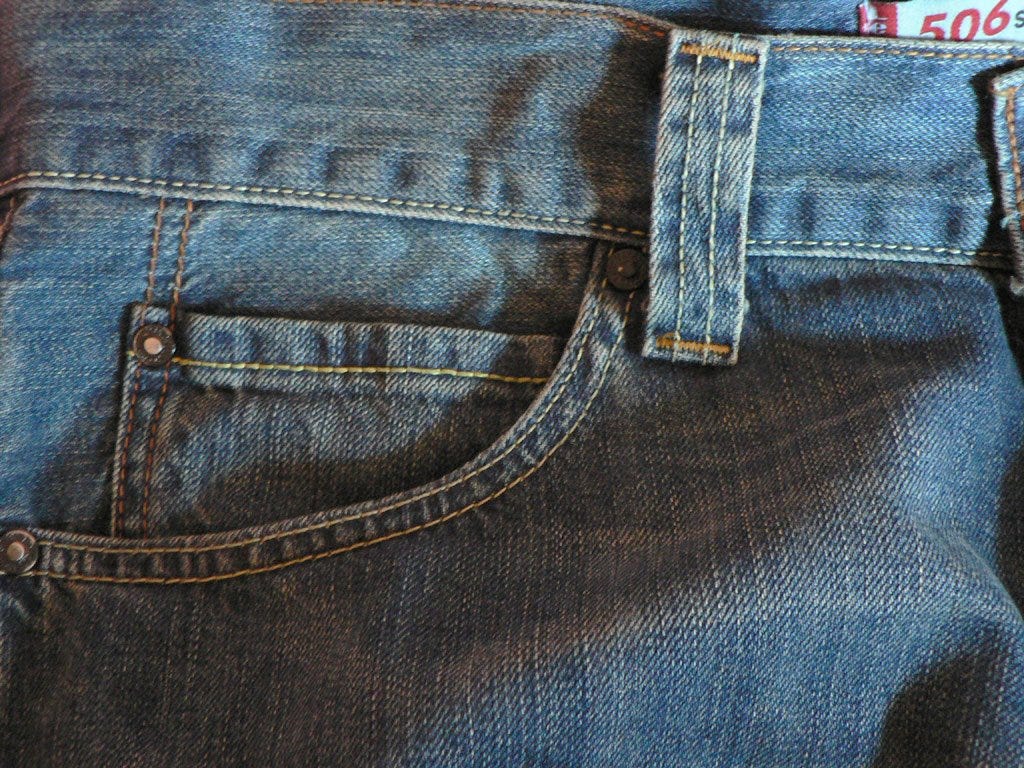

It turns out it has a name: the watch pocket. And to understand why it’s there, we have to go back a lot further than jeans.
Before the wristwatch
Ok, so let’s travel back to the 1700s.
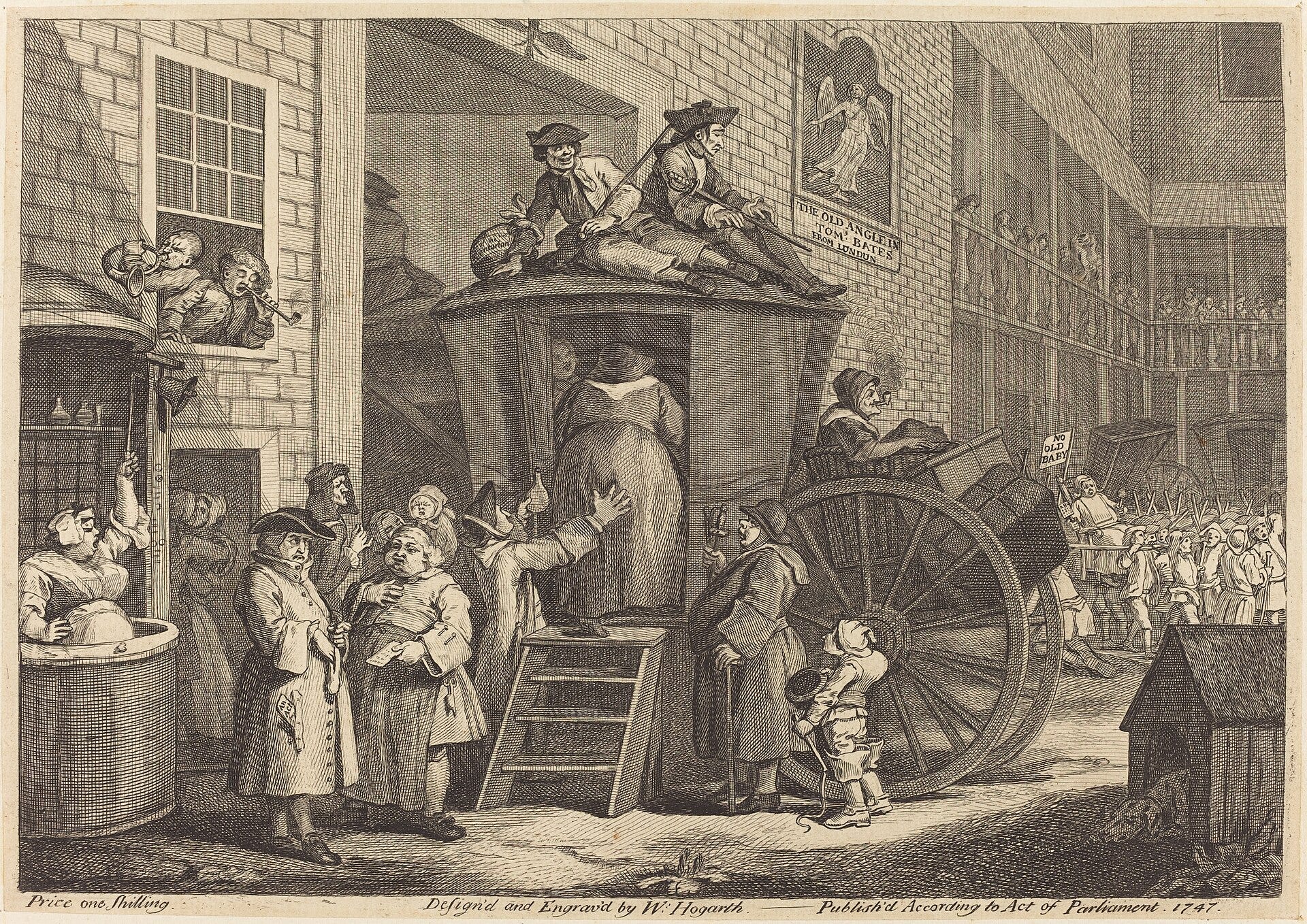
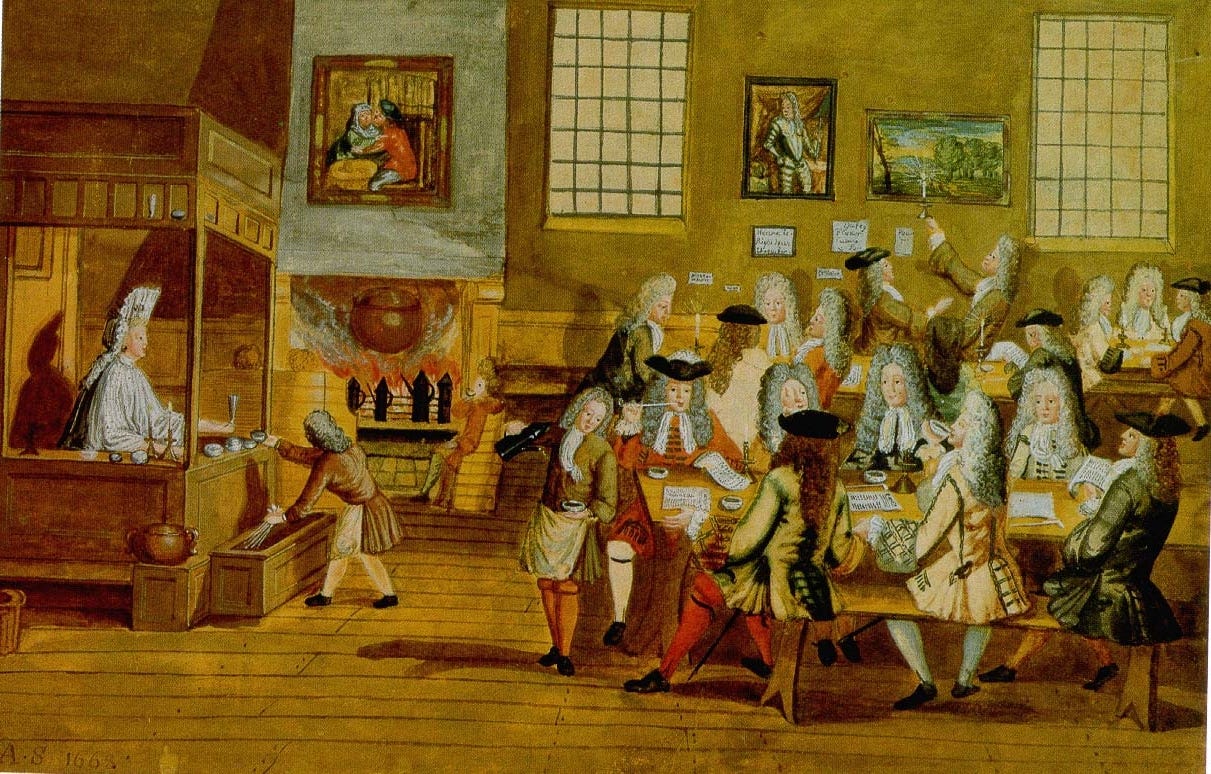
There are no cars, no planes and no electricity. Most people live in the countryside: only about 7% of the world lived in towns and cities in 1700, and in the American colonies, three-quarters of people made their living from farming. If you want to get from Edinburgh to London, about 400 miles, the coach takes 10 days in summer and 12 in winter. At night it’s candlelight, and candles are expensive enough that even a wealthy lady in 1774 was reported to sew by the light of a single candle. For fun, people play cards and dice in taverns, go to dances and read the newspaper. In London, you can pay a penny to sit in one of hundreds of coffeehouses and read the latest news.


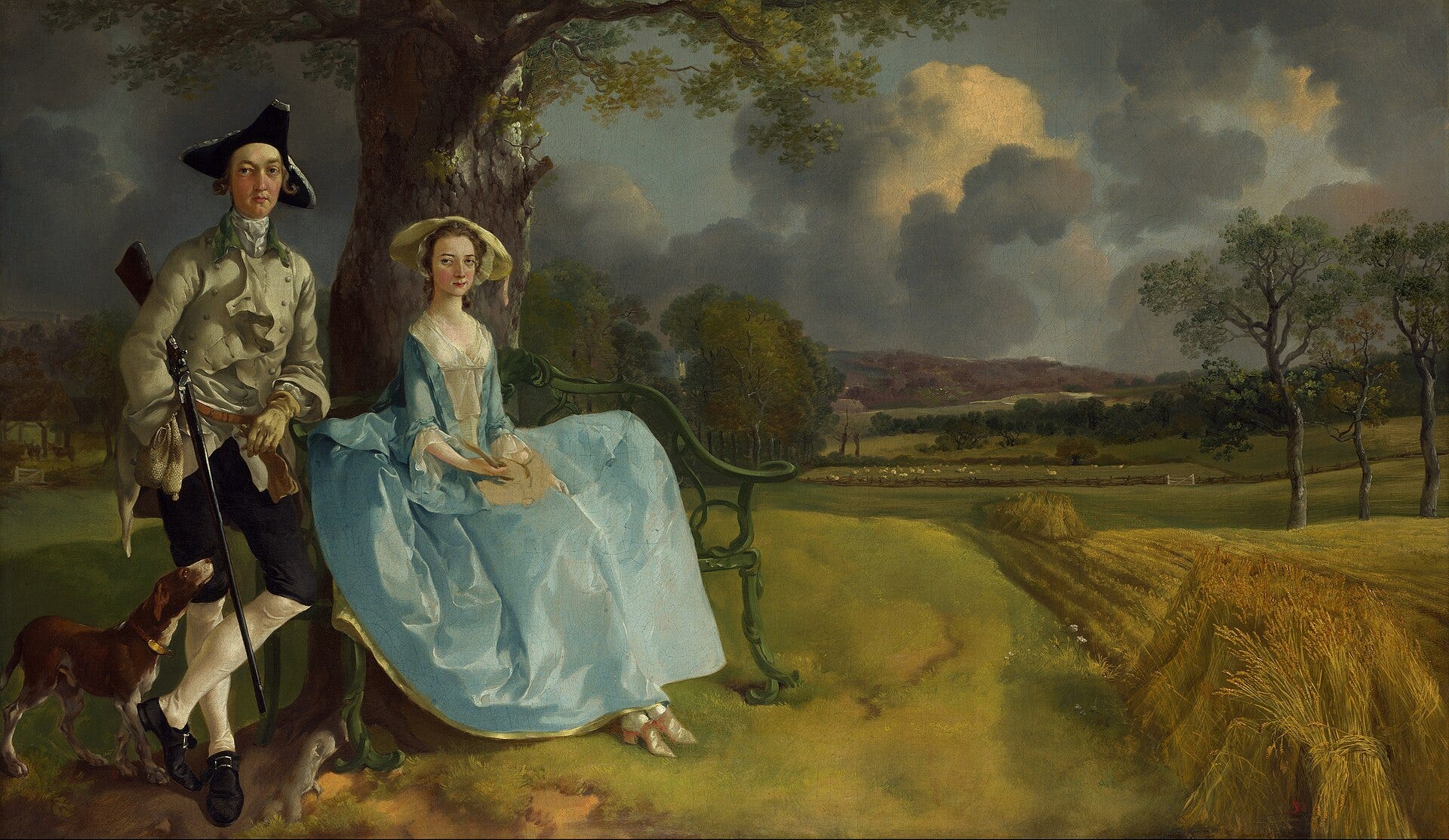
And the outfits. A gentleman wears a coat, a waistcoat and breeches (trousers that stop just below the knee), with silk stockings, a shirt and a cravat, a cloth tied around the neck. Women wear a corset and wide skirts, puffed out at the hips with frames called panniers, under an open-fronted gown that shows off the petticoat underneath. Here’s a couple painted around 1750, on their farm in Suffolk, England: him in his coat, waistcoat, breeches and stockings, her in a silk gown.

Quick note before we go on: in this article, I’ll call a watch you carry in your pocket a pocket watch, and a watch you wear on your wrist a wristwatch, just to keep things clear.
So why would anyone want a pocket watch?
Most people told the time from the church clock, and even those weren’t very accurate. People were still using sundials (a flat dial with a pointer whose shadow shows the time as the sun moves) to set them. For some people, the time started to matter for work. Mail coaches ran to a schedule, and the guard carried a “Time Bill” (a sheet listing the times and distances for each stage of the journey, basically the coach’s timetable). Workplaces started running on the clock too. At one ironworks around 1700, a bell rang at 5am to start work, at 8 for breakfast, at 12 for the midday meal and at 8pm to stop, and nobody was allowed to go by “any other clock, bell, watch or dyall but the Monitor’s” (the Monitor being the official timekeeper).
For a lot of people though, it was about showing off. A pocket watch “conferred prestige upon its owner” (made you look important), and it doubled as “the poor man’s bank,” something you could sell or pawn when money ran short.
At the start of the century, pocket watches were mostly for the rich. They were “showy fashion accessories that signaled their owners’ wealth,” and checking the time “required a flourish,” pulling the pocket watch out of your pocket for everyone to see.
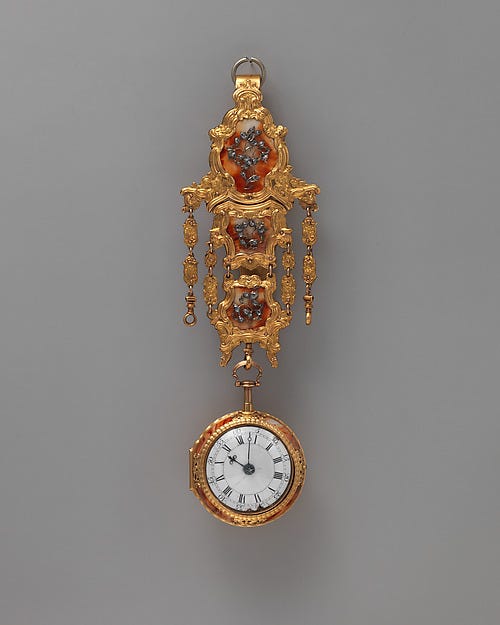
So how much did one cost? I looked into it. Two economists went through more than 3,200 pocket watches stolen in London court cases between 1685 and 1810, and in the 1720s, a typical silver one was valued at £4. To put into perspective, that was about four and a half weeks’ pay for a London building laborer, or about £464 in 2017 money (around $620), going by the UK’s National Archives converter. In 1720 a cow cost a little over £4 and a whole horse about £5.40, so a pocket watch cost about the same as a cow. Entry to a London coffeehouse was a penny, and with 240 pennies in a pound, £4 would get you in 960 times. And in 1780, a seat on the coach all the way from Edinburgh to London, about 400 miles, cost just under £5. And that’s the everyday silver one.
The most expensive pocket watch in those court records was a gold repeater (one that chimes the time when you press a button), valued at £630 in 1764. Building a small Royal Navy warship, a sloop, cost about £1,800 back then, so that one pocket watch was worth about a third of a warship…
But it wasn’t only the rich for long. The same economists found pocket watch prices fell by about 75% over the century. Pocket watches show up in fewer than 10% of the lists of what English people owned when they died around 1675, and in more than a third by the 1720s. By 1800, England had somewhere between 1.4 and 3.1 million pocket watches, roughly one for every two to four adults, and ownership among working men was “extensive.” As one historian put it, owning a pocket watch was “hardly a question of class.”
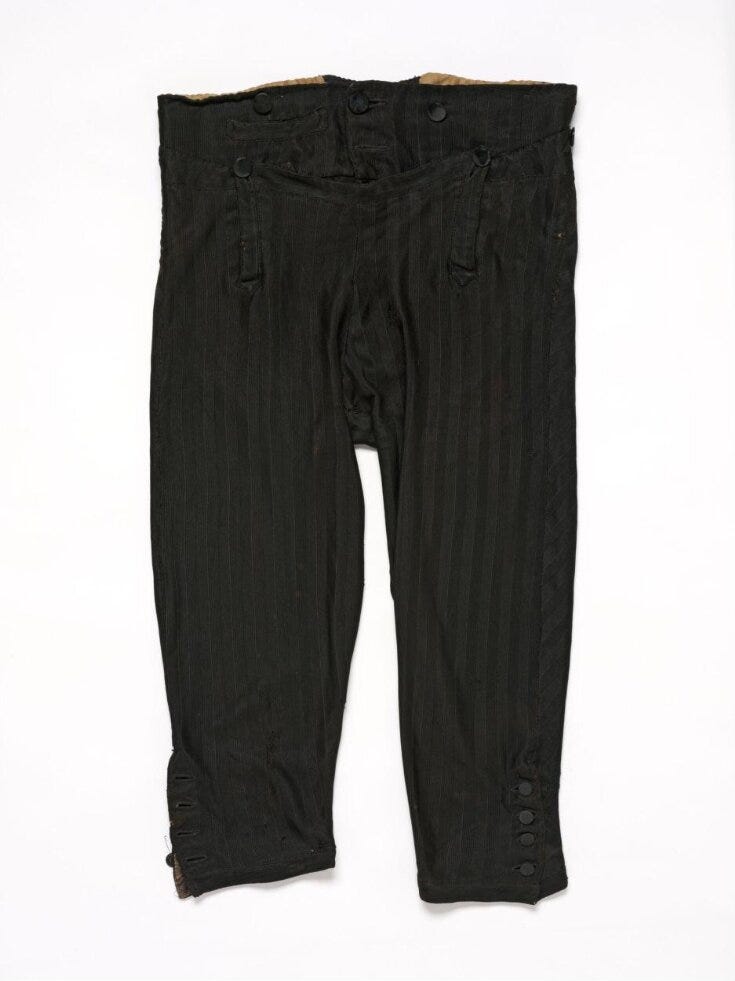
So where did men keep their pocket watch? In a small pocket in the waistband of their breeches, called a “fob pocket.” Here’s a pair of British silk breeches from the 1790s. See the small slit in the waistband, top left? That’s the watch pocket (you might have to zoom in, the breeches are all black). It’s on the left of the photo because the breeches are facing us, so for the man wearing them it was on the right, the same side as the one on my jeans, about 230 years later.
And it didn’t stay on fancy silk breeches. A pair of ordinary civilian trousers made sometime between 1785 and 1820, now in a museum in Washington, D.C., has “one small watch pocket” in the right front waistband. By the 1850s, the US Army was sewing one into its soldiers’ trousers, “on the top edge of the right front waistband,” and it was still there on army trousers, Union and Confederate, all through the Civil War (1861 to 1865).
By the mid-1800s, most men wore a three-piece suit, and the waistcoat became the place to keep a pocket watch, in the vest pocket on a chain. But the watch pocket in the trousers hung on.
Why the watch pocket was good design
Before we get to jeans, I want to look at why this little pocket made so much sense at the time. Using Don Norman’s design principles (I wrote about his book in good design is hard to notice):
Affordance (what an object lets you do with it): a small pocket sized for one thing, a pocket watch. The one on an early pair of Levi’s in a museum is 9.5 by 8.3 cm.
Signifier (the signal that tells you what to do): the pocket watch’s chain, key and seal hung outside the pocket, so you could see exactly where it was and grab it by the chain.
Mapping (how the thing you touch relates to what happens): it sits right at the waistband, and the chain leads your fingers straight to the pocket watch.
Conceptual model (a simple explanation in your head of how something works): everyone knew what it was for. It was called a watch pocket, and it held a pocket watch.
Then came jeans
In the early 1870s, a tailor in Reno, Nevada, called Jacob Davis started putting copper rivets on the corners of work pants, because the seams kept ripping. He partnered with Levi Strauss & Co., and in 1873 they got a patent. As Davis put it, “the seams are usually ripped or started by the placing of the hands in the pockets.” The watch pocket isn’t mentioned, and it isn’t in the drawing either.
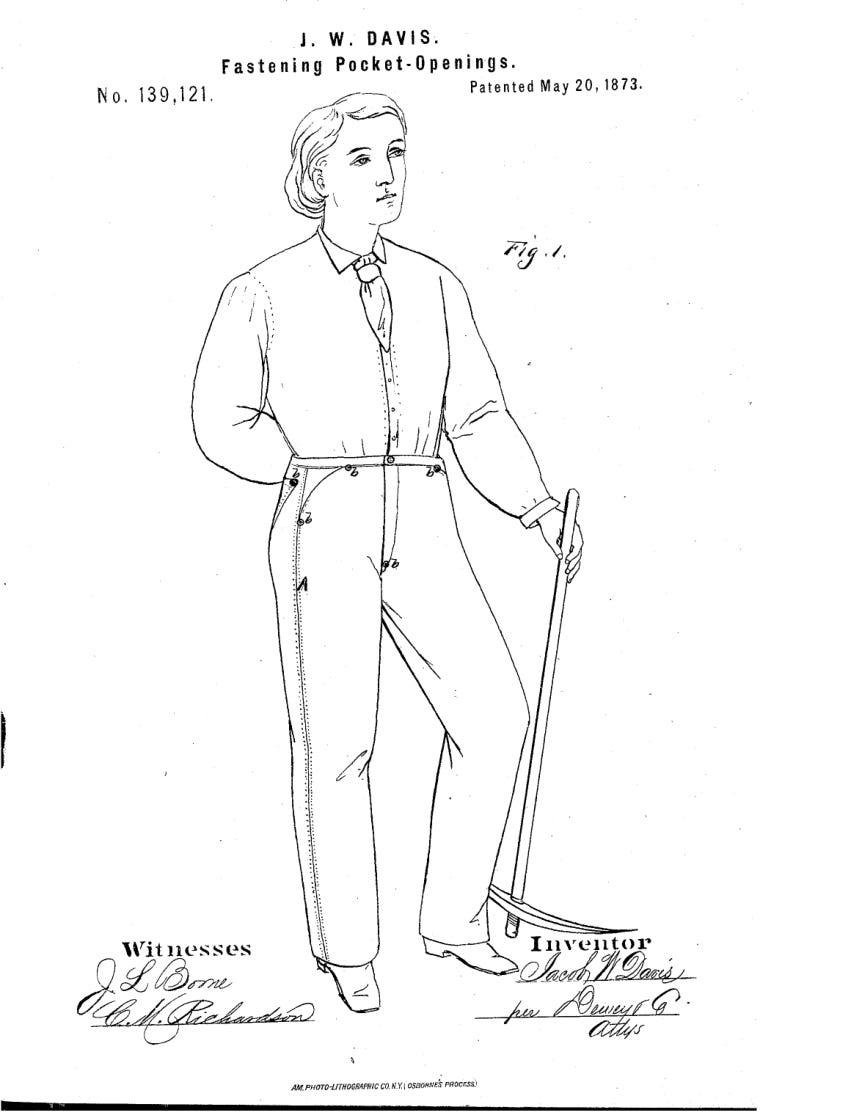
But the pocket was on the jeans. Levi’s says its very first jeans had four pockets: “only one in back and, in the front, two plus the small, watch pocket.” The oldest pair in its archive, from around 1879, has one. On a roughly 133-year-old pair found in a barn, Levi’s historian pointed to a circular shadow on the upper right, worn into the denim by a pocket watch.
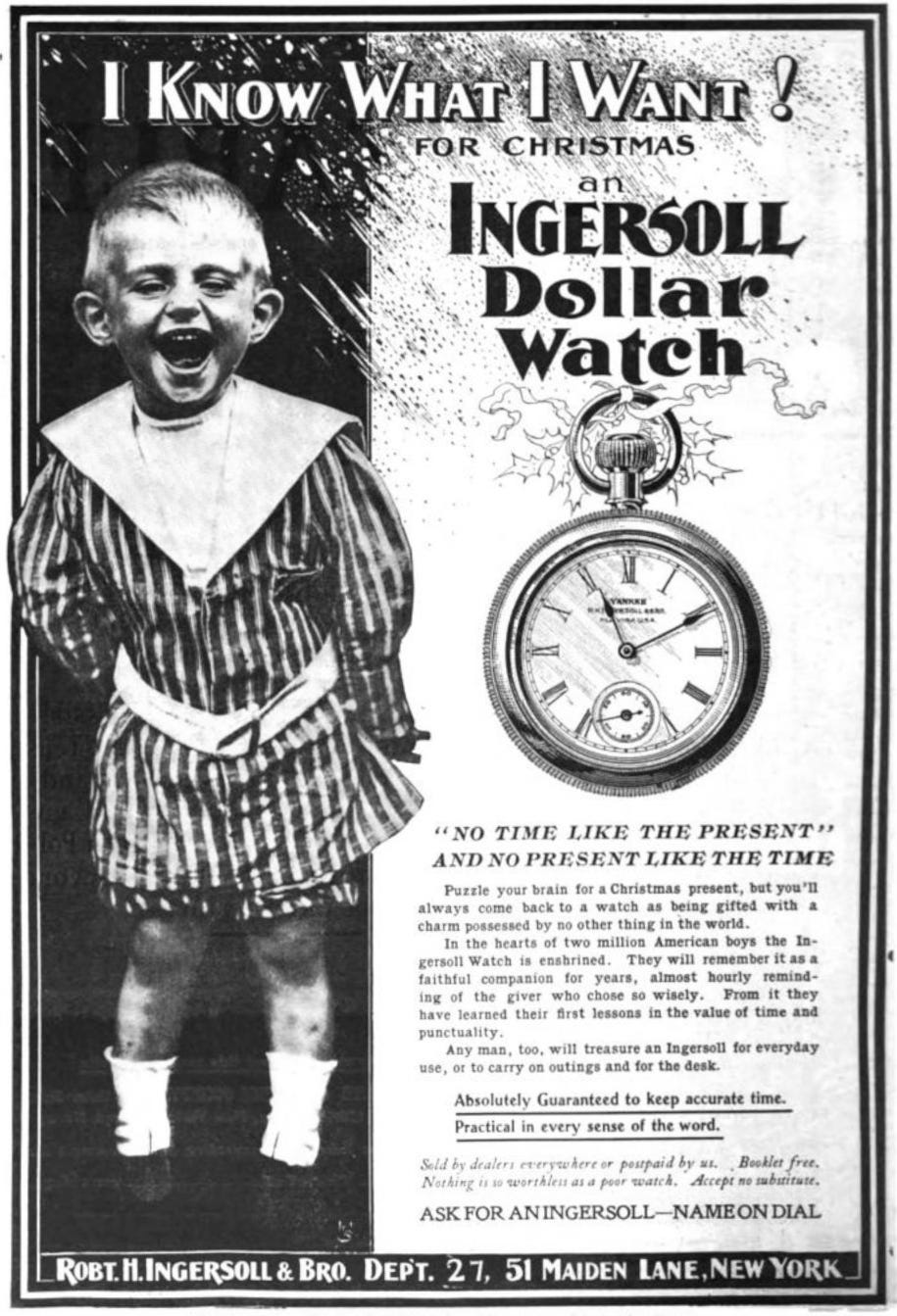
These were work pants, sold to “storekeepers, surveyors, teamsters, farmers,” and by the 1890s to railroad workers and miners too. And this is right when pocket watches got cheap enough for anyone. In the 1850s, a company in Waltham, Massachusetts, made the world’s first mass-produced pocket watches, and by the 1890s Ingersoll was selling a pocket watch for one dollar, selling 12,000 a day by the early 1900s.

For railroad workers especially, the pocket watch mattered. In 1891, two trains collided near Kipton, Ohio, and nine men died. The investigation centered on an engineer’s pocket watch that was “possibly four minutes slow,” and it led to strict standards for the pocket watches railroad workers carried, two years later.
Over the years the pocket picked up a lot of other names. Levi’s lists the “frontier pocket, condom pocket, coin pocket, match pocket and ticket pocket, to name a few.” You’ll also find stories online that it was for miners’ matches, or gold nuggets.
The wristwatch takes over
So what happened to the pocket watch? World War I. Before the war, men saw wristwatches as “feminine jewelry.” Then soldiers went to war, and some “experimented with fastening pocket watches to their sleeves or their legs.” As the war went on, “the wristwatch became ubiquitous among male soldiers.” By 1917, a British watchmaking journal said the wristwatch “was little used by the sterner sex before the war, but now is seen on the wrist of nearly every man.”
So the watch pocket lost its pocket watch.
The pocket stayed though. Fun fact: During World War II, Levi’s even took the rivets off the watch pocket to save metal for the war effort and in 1947 the rivets went back on.
Why it’s still there
So if the pocket watch is gone, why does every pair of jeans I own still have one, Calvin Klein included?
Levi’s answer is heritage: “To preserve the integrity of the early design, Levi Strauss & Co. maintains the watch pocket.” It sits alongside the rivets, the button fly and the leather patch as an original part of the jeans. Other brands say much the same. One denim brand keeps it “because denim without history is just… pants,” and a denim shop calls it “entirely vestigial” (left over from a function it no longer has), kept because removing it “would look wrong.”
Remember the conceptual model? That’s what broke. The watch pocket was good design for a pocket watch. Take away the pocket watch, and nobody knows what it’s for anymore, which is exactly the question I started with. So I went looking for people who do use it, and found a Reddit thread asking exactly that: “What do you utilize the ‘pocket watch’ pocket for?” The most common answer by far was a Zippo lighter, followed by AirPods. People also keep a quarter for the shopping cart at Aldi, a sobriety chip, their wedding ring while they wash their hands, a guitar pick (“You never know when a guitar will present itself and you need to shred”), and one person who had heart bypass surgery keeps their nitroglycerin pills in there. And my favorite: “Whatever I put in there, the washing machine is usually responsible for taking it out.”
As for my AirPods case, it fits, technically. It’s about 6 cm wide and 2 cm thick, so it goes in, but it’s a squeeze. And I’m still not getting it back out with two fingers. I think I’ll keep using the big pocket.