

When I read, I like to take notes. Especially if it’s a book I want to remember things from (like The Design of Everyday Things). The notes I take are sometimes digital (on a notes app) or physical in a notebook. Lately, I’ve been using this nice navy blue notebook that was lying around at home and it just so happens to be my favorite color.
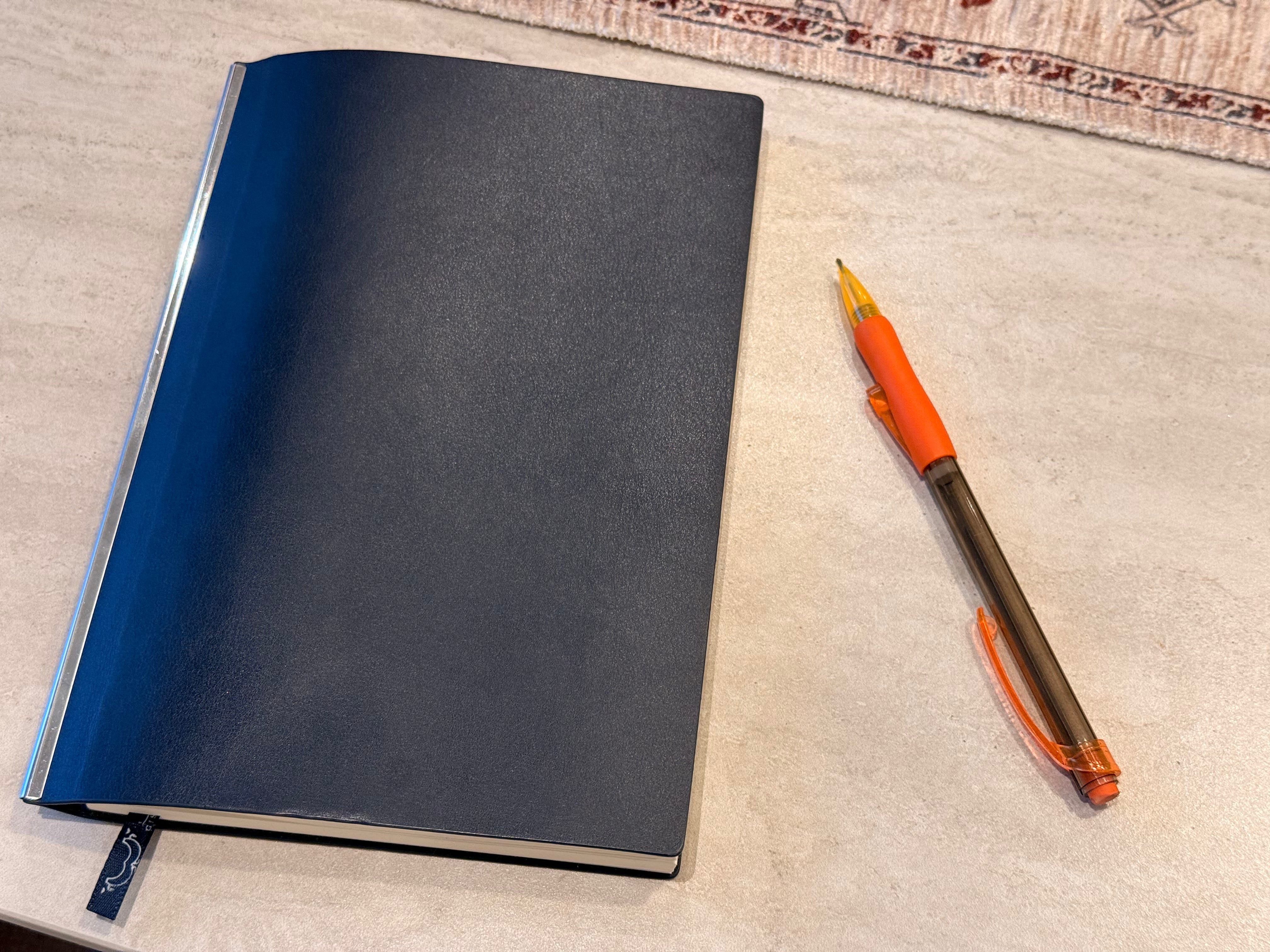
As for the writing equipment: I use a cheap orange mechanical pencil I bought from Dollarama. I’ve used mechanical pencils ever since I was first introduced to them. To me, they’re quite the product. The 0.5 / 0.7mm lead (by lead, I mean the thin grey stick inside that you write with, not the metal, more on that later) means the tip is always sharp, which gets rid of the need for a sharpener, and the mess that comes with it.
Since it’s still a pencil, you can erase any mistakes you make while writing. The only downsides are running out of lead refills at an awkward time and the rubber on the back finishing quickly.
All this got me thinking about who invented the mechanical pencil and how it came about! Turns out every version of it was someone fixing one annoying thing about the version before. Here’s what I found.
Problem 1: you needed a knife
Before we actually talk about the problem, a quick detour: there’s no actual lead in a pencil, and there never was! In the 1560s, people in Borrowdale, a valley in the north of England, found a deposit of really pure graphite. It looked and marked like lead, so that’s what everyone called it. In 1779 a chemist showed it was actually a form of carbon, but by then the name had stuck.
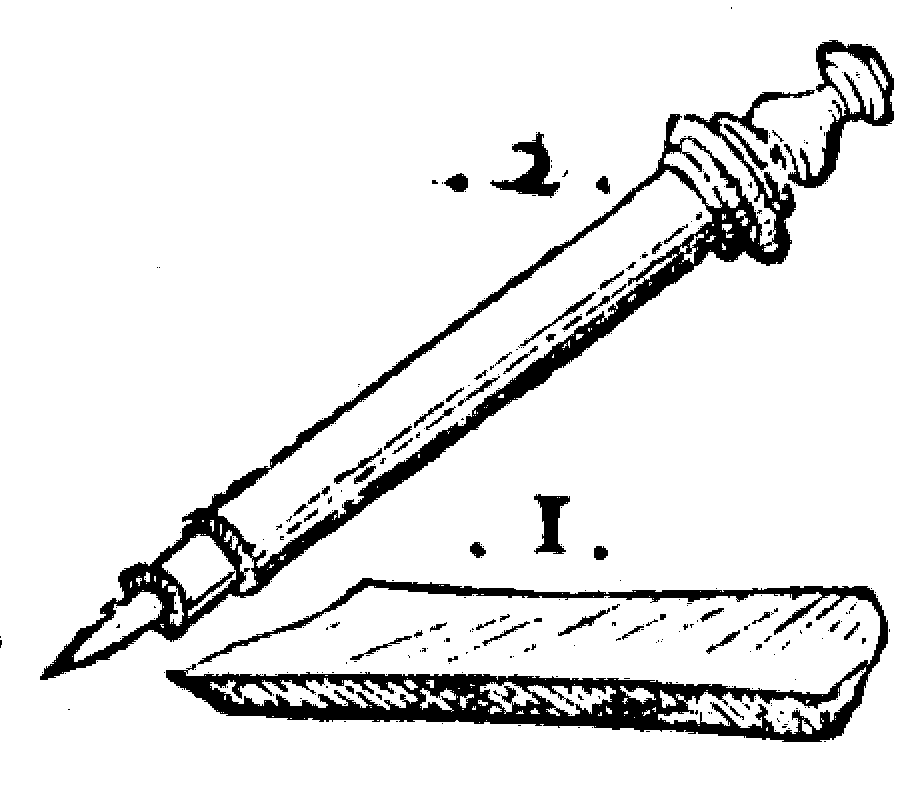
Ok, so back to needing a knife. In 1565, a Swiss naturalist called Conrad Gesner described “a sort of lead... shaved to a point and inserted in a wooden handle.” He even drew it, and it already looks a lot like a mechanical pencil. But you still had to push the lead along and sharpen it yourself, with a knife.

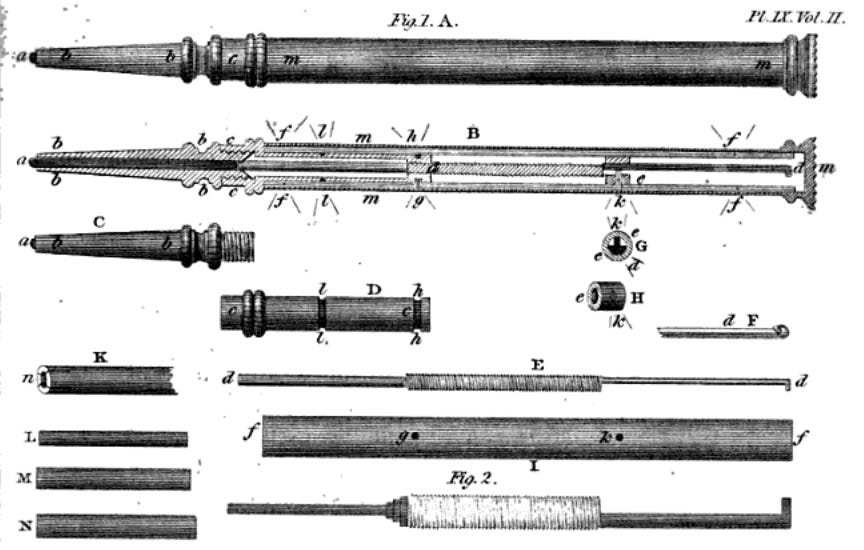
Pencils needed a knife for a long time after that. Then in December 1822 (over 250 years later!), two Londoners, Sampson Mordan and John Isaac Hawkins, got a British patent for “improvements on pencil holders.” The patent says the whole point was to make “the frequent cutting or mending of the nibs or points unnecessary.” Their pencil worked like a glue stick: you twist the end of the pencil, and a threaded rod inside turns and pushes the lead out a little at a time. Twist pencils like this stayed the most common type for over a hundred years.

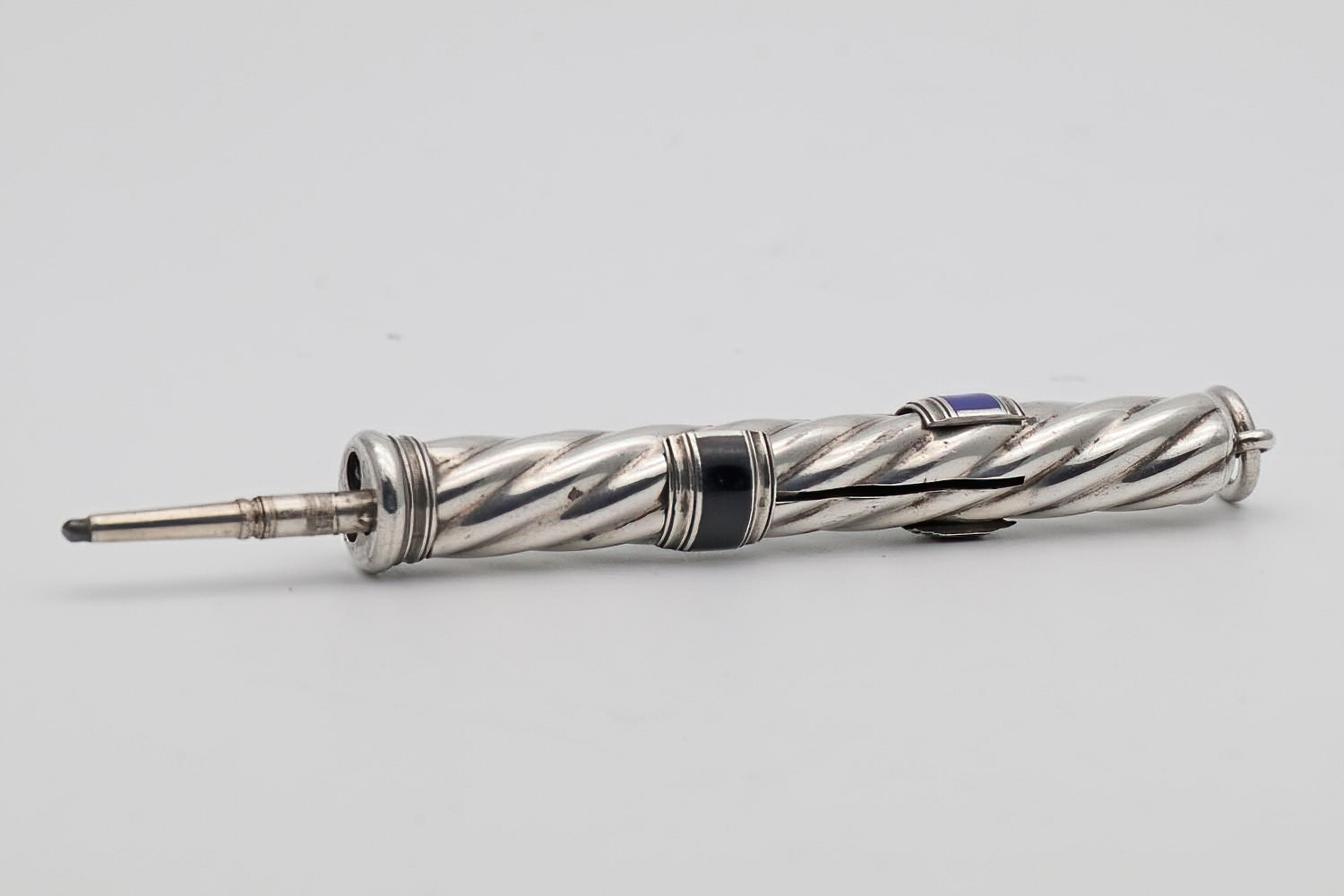
These weren’t cheap, though. Mordan’s were made of silver, and Victorian pencils were treated like jewelry, worn on a chain alongside scissors and sewing tools. The male guests at Queen Victoria’s wedding in 1840 were even given gold ones as gifts.

(Mordan wasn’t technically first, though. Divers found a piece of a sliding pencil in the wreck of HMS Pandora, a British ship that sank off Australia in 1791.)
Problem 2: it was fragile and fancy
Ok, now we need to take a trip to Tokyo, almost a hundred years later, where Tokuji Hayakawa ran a small metalworking shop. His first hit was a belt buckle that held the belt tight without needing any holes.
In 1915, a big pen company ordered a load of metal parts from him for their mechanical pencil. The pencil had a thick, clunky casing made of celluloid (an early type of plastic), and it broke easily. It was basically an expensive toy. Hayakawa was only hired to make the parts inside, but he thought he could make the whole pencil properly useful, the way a fountain pen was.
So he redesigned it. He replaced the mix of small parts inside with a single piece of brass, which made it much tougher, and swapped the plastic casing for nickel-plated metal. A year later, his sales agent gave it a catchier name: the Ever-Ready Sharp Pencil.
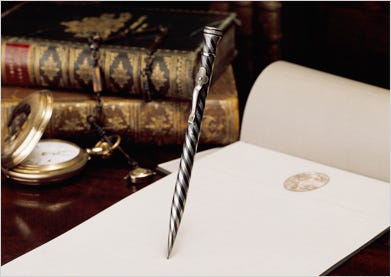
Shops in Japan didn’t want it at first. They said it didn’t go with a kimono, and the metal felt cold to hold in winter. (Most people in Japan still wore traditional clothes back then, and pencils had only just started being made there, so a shiny metal pencil felt out of place.) Then World War I left Europe short on supplies, a trading company in Yokohama placed a big order, and the pencils started selling overseas. “Sharp pencil” is still the word for a mechanical pencil in Japan today.
Then on September 1, 1923, the Great Kanto earthquake hit Tokyo. Hayakawa lost his two children and his wife in the fires. He was in debt, so he handed the pencil business and its patents over to pay it off, moved to Osaka and started again. In 1925 his new company made Japan’s first crystal radio, and he named it Sharp, after the pencil. That company is still around today as Sharp, a Japanese electronics company that sells TVs, microwaves and other electronics in well over 100 countries. You may have heard of them (I hadn’t!).
Around the same time in the US, Charles Keeran patented a pencil in 1915 that he called the Eversharp (the two names get mixed up a lot, but they were separate pencils). It was the first one made in huge numbers with a simple mechanism and room for lots of spare lead. By 1921 the factory was making 35,000 a day and had sold over 12 million. So the mechanical pencil went from a silver wedding gift to something a lot more people could own.
Problem 3: the lead was thick and snapped
The Eversharp’s lead was about 1.2mm thick, more than twice as thick as the 0.5mm in most pencils today, and that became the standard size. Going much thinner wasn’t really an option, because of what the lead was made of.
Since 1795, leads had been made using a method from a Frenchman called Nicolas-Jacques Conté. France was cut off from English graphite at the time, so he came up with a new way to make leads: grind the graphite into powder, mix it with wet clay, shape it into sticks and bake them. It worked, but clay is brittle, so a really thin lead would just keep snapping.
Jumping ahead 165 years, in 1960 the Japanese company Pentel launched what it calls the world’s first lead made with plastic resin instead of clay, in 0.5, 0.7 and 0.9mm. Swapping clay for resin is what made leads that thin strong enough to use. The same year it released a click pencil that, in Pentel’s words, never needs its lead sharpened. That’s basically the pencil I use today. Now 0.5 and 0.7mm are the most common sizes.
(The H and B on leads, by the way, are usually read as hardness and blackness. HB, right in the middle, is the standard one for writing.)
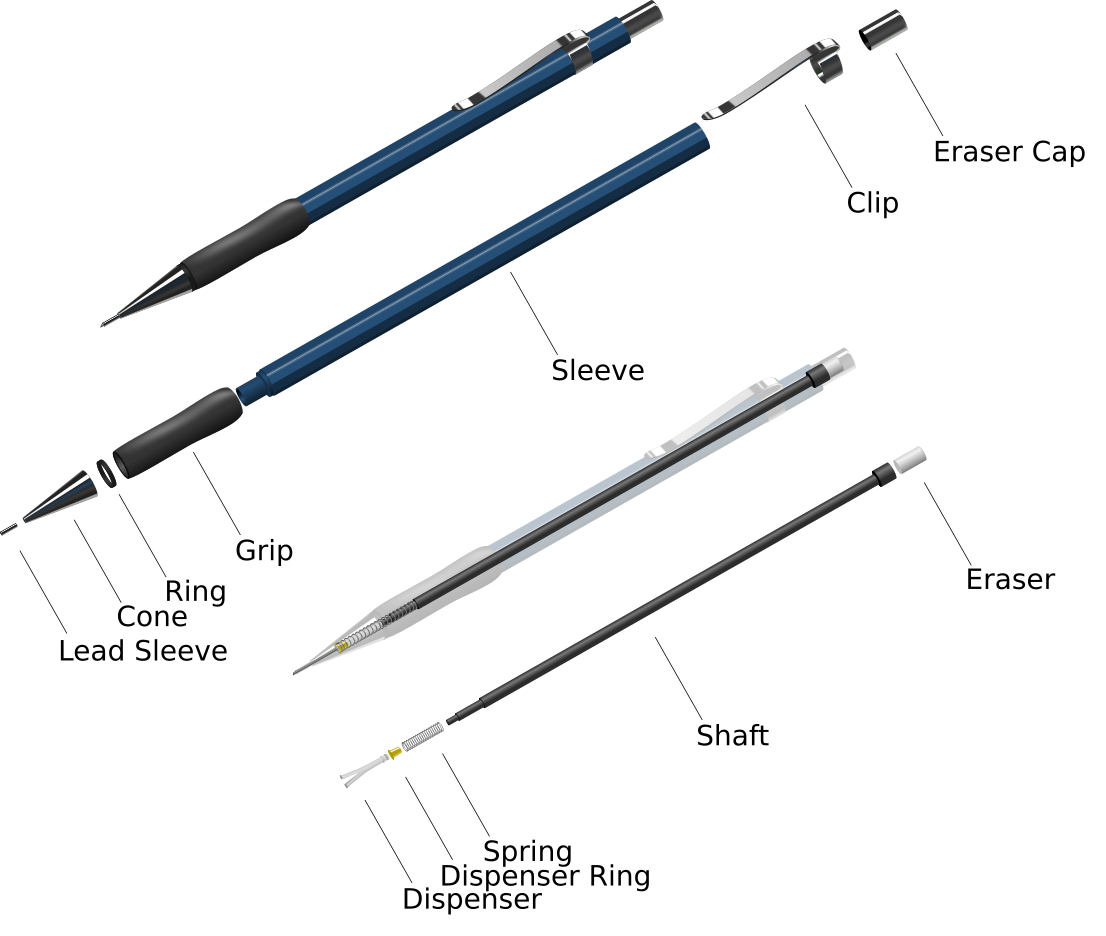
So how does the click actually work? Think of it like pulling a rope towards you hand over hand: grab, pull, let go, reach back, grab again. Inside the pencil there’s a tiny metal claw holding the lead.
Press the button: the claw moves forward, carrying the lead with it, then opens and lets go.
Let go of the button: the claw slides back up. A small rubber ring at the tip holds the lead still, so it doesn’t slide back too.
The claw grabs the lead again, a little further up.
Each click repeats that, so the lead moves forward a tiny bit at a time. This short animation shows it really well.

Problem 4: thin lead wears down lopsided
If you’ve used a mechanical pencil for a while, you’ve probably noticed the tip wears down at a slant. Mitsubishi Pencil, the Japanese company that makes uni-ball pens (and no relation to the Mitsubishi that makes cars), says this makes your lines get thicker, makes the lead break more easily, and leaves crumbs that smudge the page.
Their fix was the Kuru Toga in 2008. It has tiny gears inside that turn the lead a little with every stroke, so the point wears evenly and stays sharp. It’s sold over 100 million. You can see the gears turning in their video (also, it’s refreshing to see a launch video from before AI that isn’t heavily edited).
Other companies went after the snapping instead. Zebra’s DelGuard has springs that absorb pressure so the lead doesn’t break, and Pentel’s Orenz has a metal tip that slides back as the lead wears down, so you can keep writing without clicking.
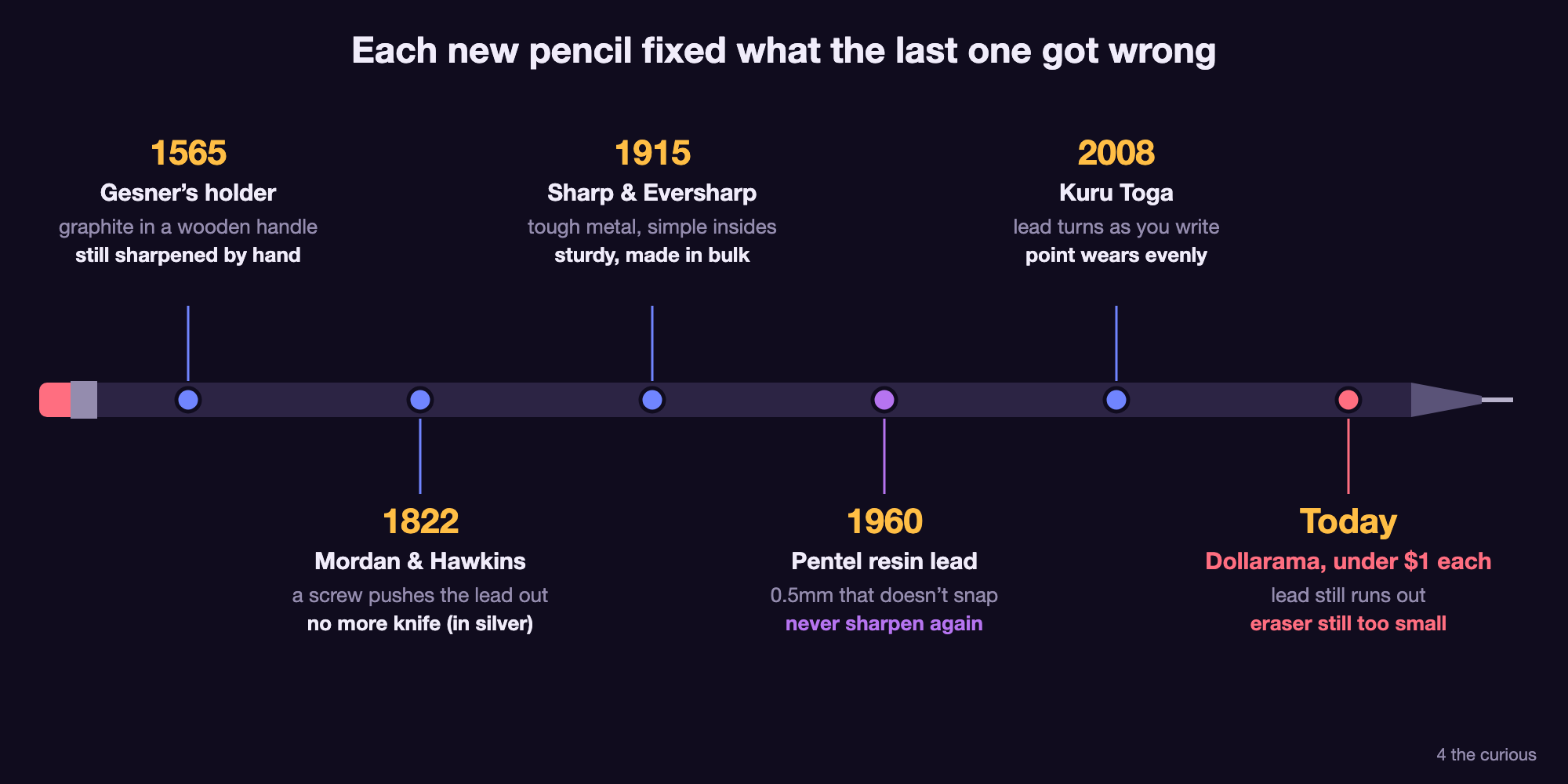
Here’s the timeline we just covered:
Back to my two problems
So after all that, my two problems from the start are still there.
Running out of lead hasn’t really been fixed. In 1978 the Japanese pen company Pilot made a pencil you shake to push the lead out instead of clicking, and in 2017 Pentel made one that feeds the lead out for you as you write. But with all of them, you still have to buy refills and load them yourself.
And the eraser has been an add-on from the start. Putting one on the end of a pencil was patented in the US in 1858 by a man called Hymen Lipman. He sold the patent for $100,000, and then in 1875 the Supreme Court threw it out, because it was just two things that already existed stuck together lol.
The pencil went from silver and gold to under a dollar at Dollarama in about 200 years.