

Since I’ve started to learn more about design, I find myself naturally thinking about the good and bad design of the apps, tools and services I use. For instance, my dad was submitting a complaint on a hospital app because he still hadn’t received his lab results, a few weeks after a test that should’ve taken one. After typing out his rather passive aggressive message, he couldn’t submit it!
The keyboard didn’t have a submit or enter button. When he handed me the phone, fuming, I noticed the green submit button was actually sitting behind the see-through keyboard. There was no button to hide the keyboard either. The message box filled the whole screen, so tapping anywhere just moved the cursor around his message, and every missed tap on the keyboard added another typo to the message he’d so angrily written.
After about a minute of this, we managed to scroll using the sliver of screen on either side of the message box, tapped some white space, and the keyboard finally went down. And voila, there was the submit button.
That was a minute of annoyance. But when something doesn’t work the way it’s supposed to, it can cost a lot more than a minute, which brings me to today’s topic: the panic bar.
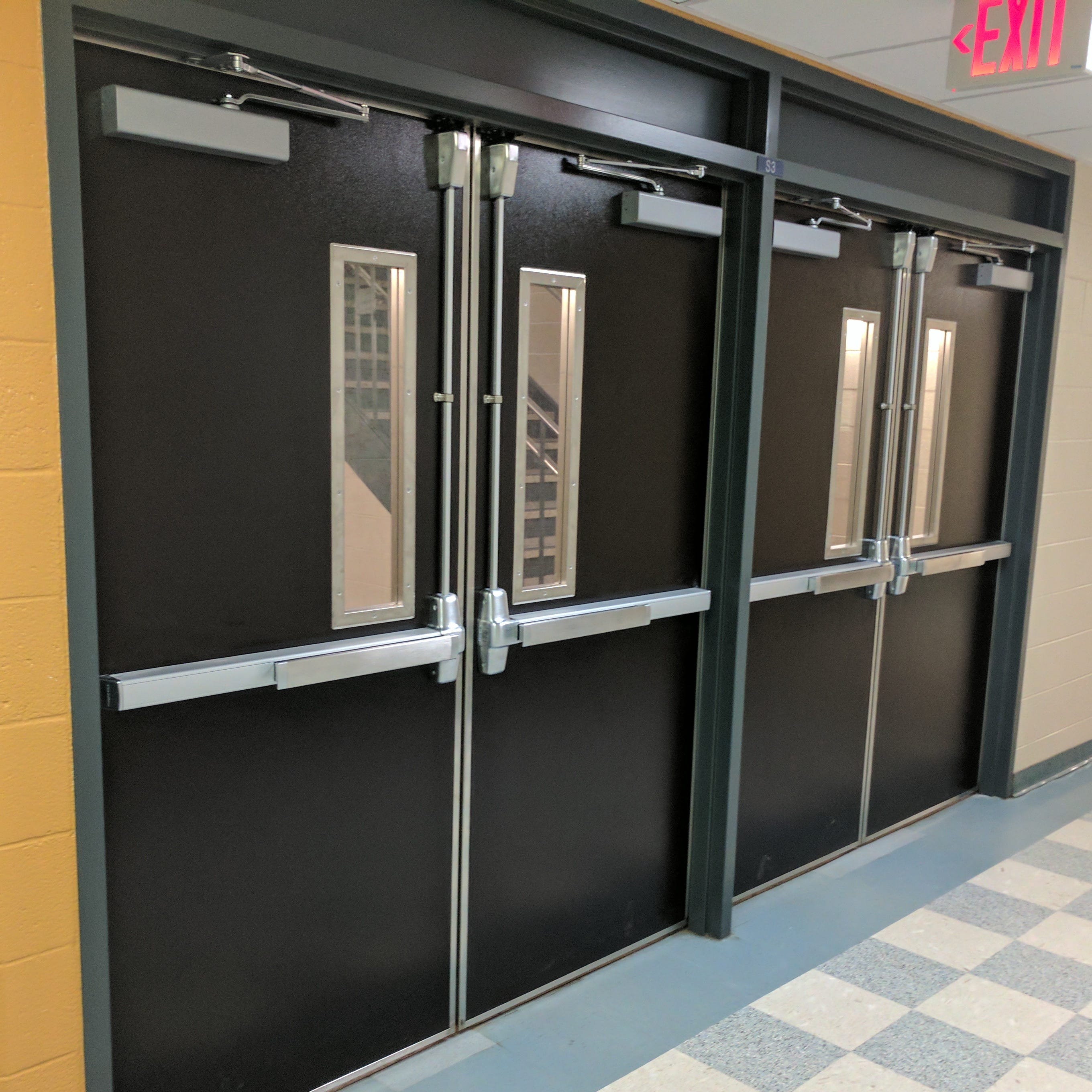

You’ve likely seen a panic bar on your office building’s stairwell doors, at government buildings, museums, basically any large public space. You probably didn’t give it a second thought. How complicated could it be? How could it even have a history? It’s just a door that you push open. What more could there be to this? Well, unfortunately, a couple of hundred dead children.
A free show in Sunderland
It was a beautiful, bright and warm day on Saturday, 16 June 1883, in Sunderland, a port town in the north east of England. Alexander Fay, a traveling entertainer, was putting on a children’s show that afternoon at the Victoria Hall, a big brick hall that could seat around 2,500 people. Tickets were a penny, and about 2,000 children showed up, with very few adults to watch over them.
The hall had three levels: the ground floor, a middle level called the dress circle, and the gallery at the top. Around 1,100 kids sat up in the gallery. To get down, they had to take a winding staircase with a door near the bottom.
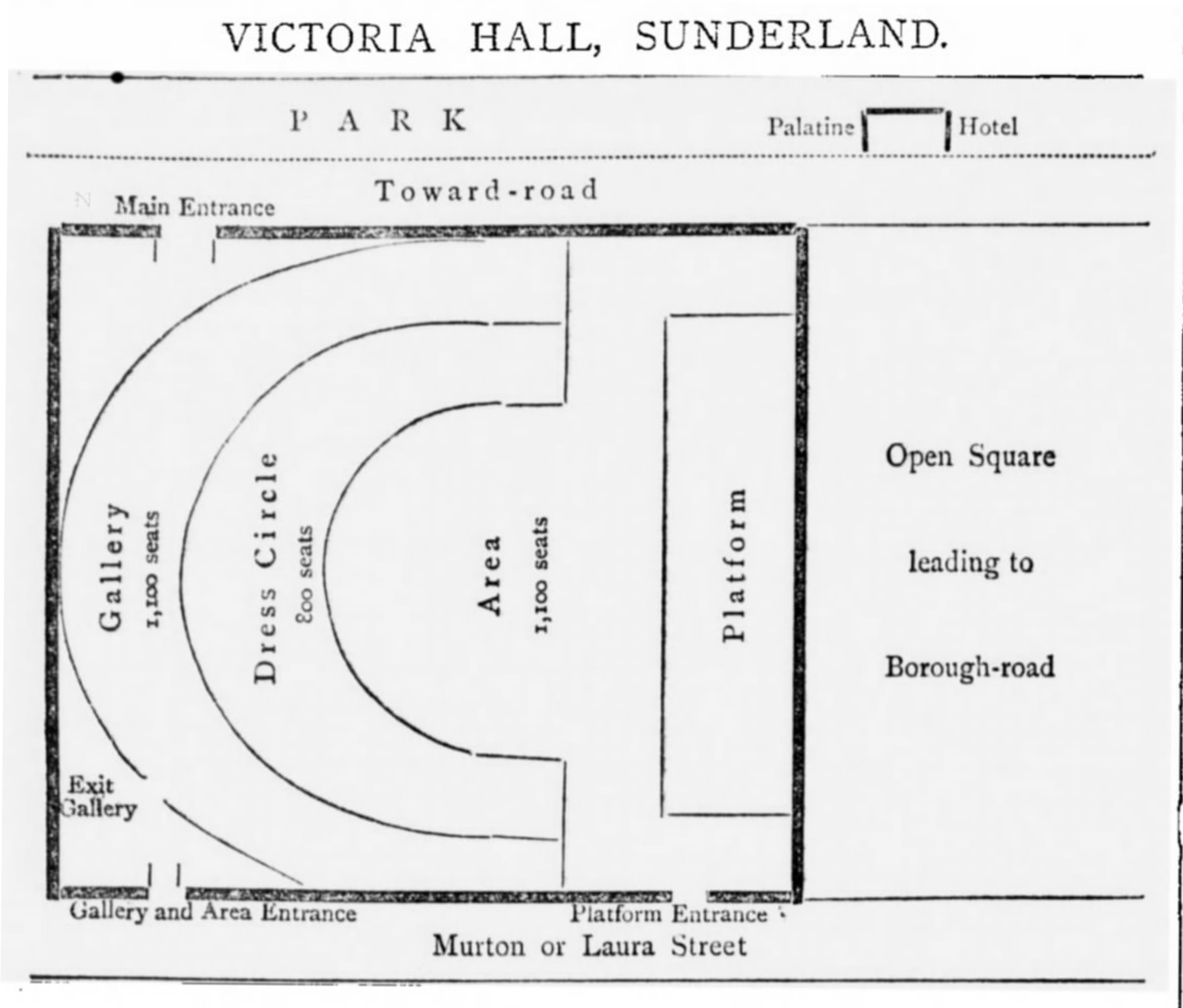

At the end of the show, the entertainers started handing out toys and books from the stage, to the kids on the ground floor. The gallery kids saw that and ran for the stairs, worried there would be nothing left for them.
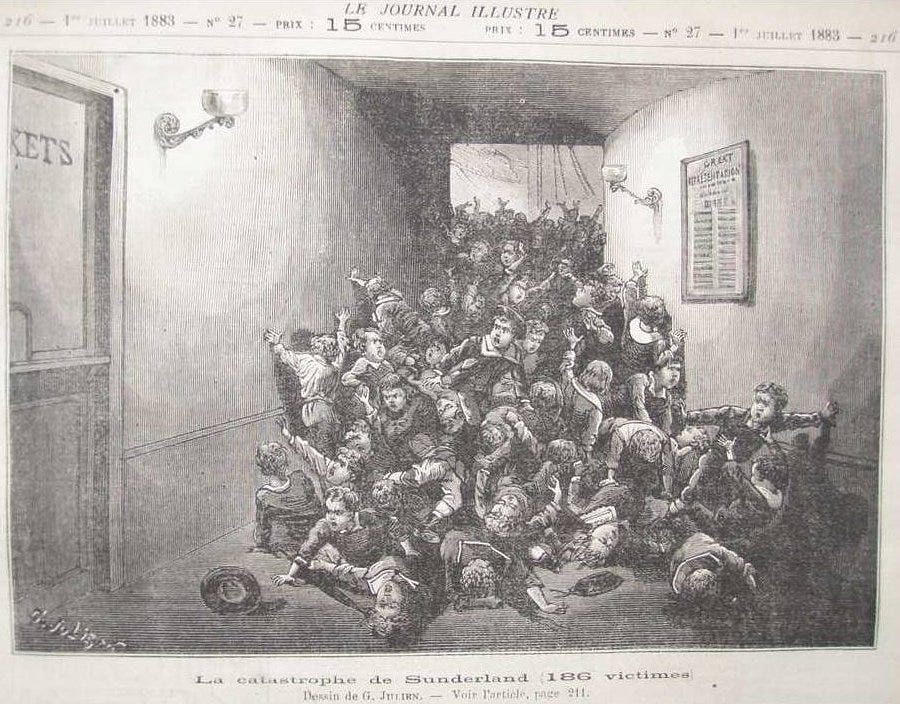
But unfortunately for them, the door near the bottom of the stairs had been bolted into the floor, partly open. The gap was 1 foot 10 inches, just enough for one child at a time. So now you have 1,100 kids running down the stairs, all needing to get through a door that only fits one of them.
The kids at the front couldn’t stop, because everyone behind them kept pushing, and the kids at the back had no idea anything was wrong. One boy, William Codling, who was six or seven at the time, wrote about it years later:
Suddenly I felt that I was treading upon someone lying on the stairs and I cried in horror to those behind “Keep back, keep back! There’s someone down.” It was no use, I passed slowly over and onwards with the mass
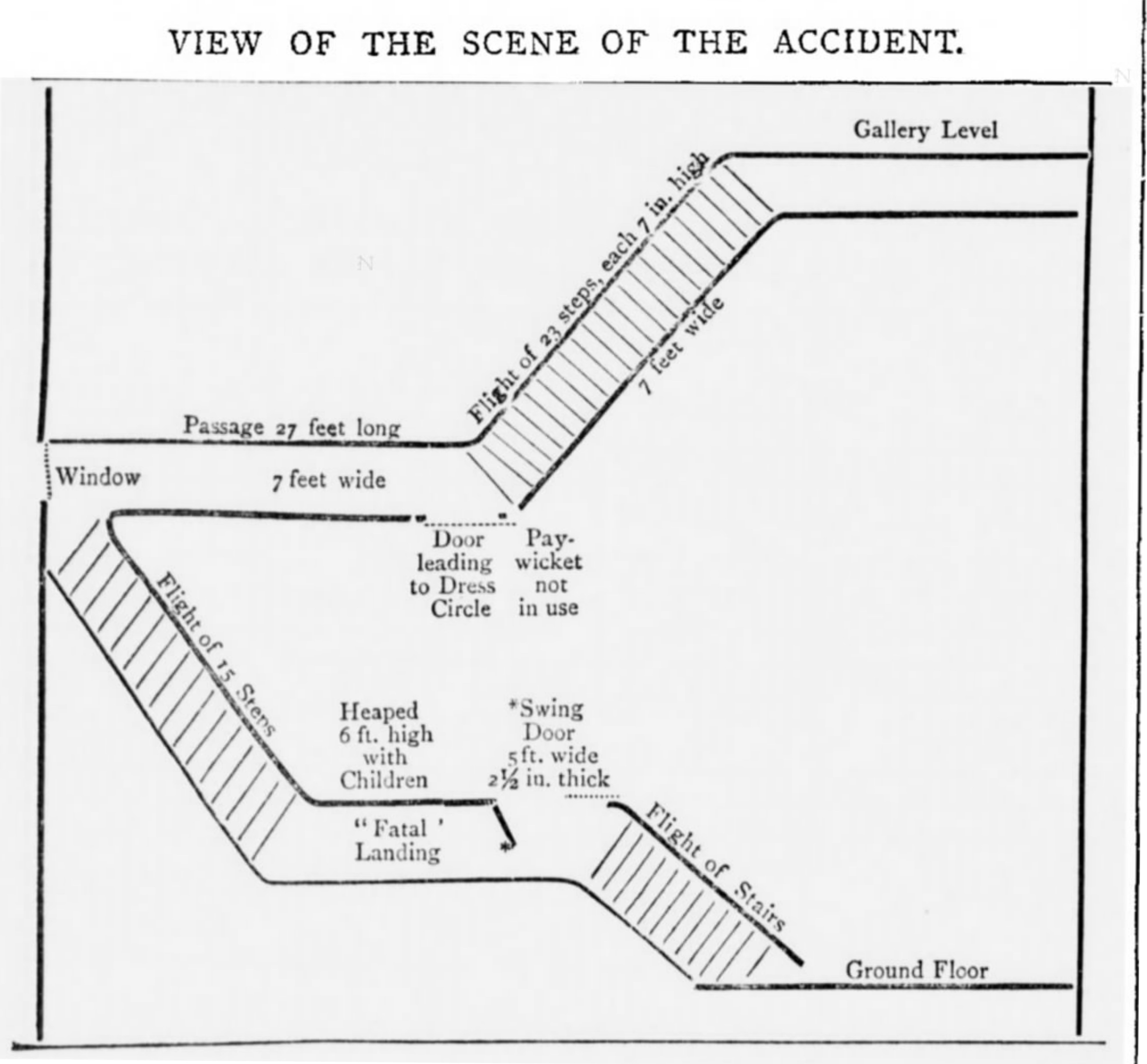
Bodies piled up in the gap between the door and the wall, and the pressure was so strong that the bolt holding the door actually bent. For context, crowds have been known to push with over 1,000 pounds of force, enough to bend steel railings. When everything settled, 183 children had died, many of them just 7 or 8 years old.

A relief fund raised £5,769 (about $28,000 USD at the time) for the families, and Queen Victoria herself gave £50 (about $240). Side note - £50 from the Queen sounded low to me, so I looked it up: £50 back then was worth about £3,300 in today’s money (around $4,400), or around five months of a skilled worker’s wages. Still feels a bit low coming from the Queen, if you ask me.
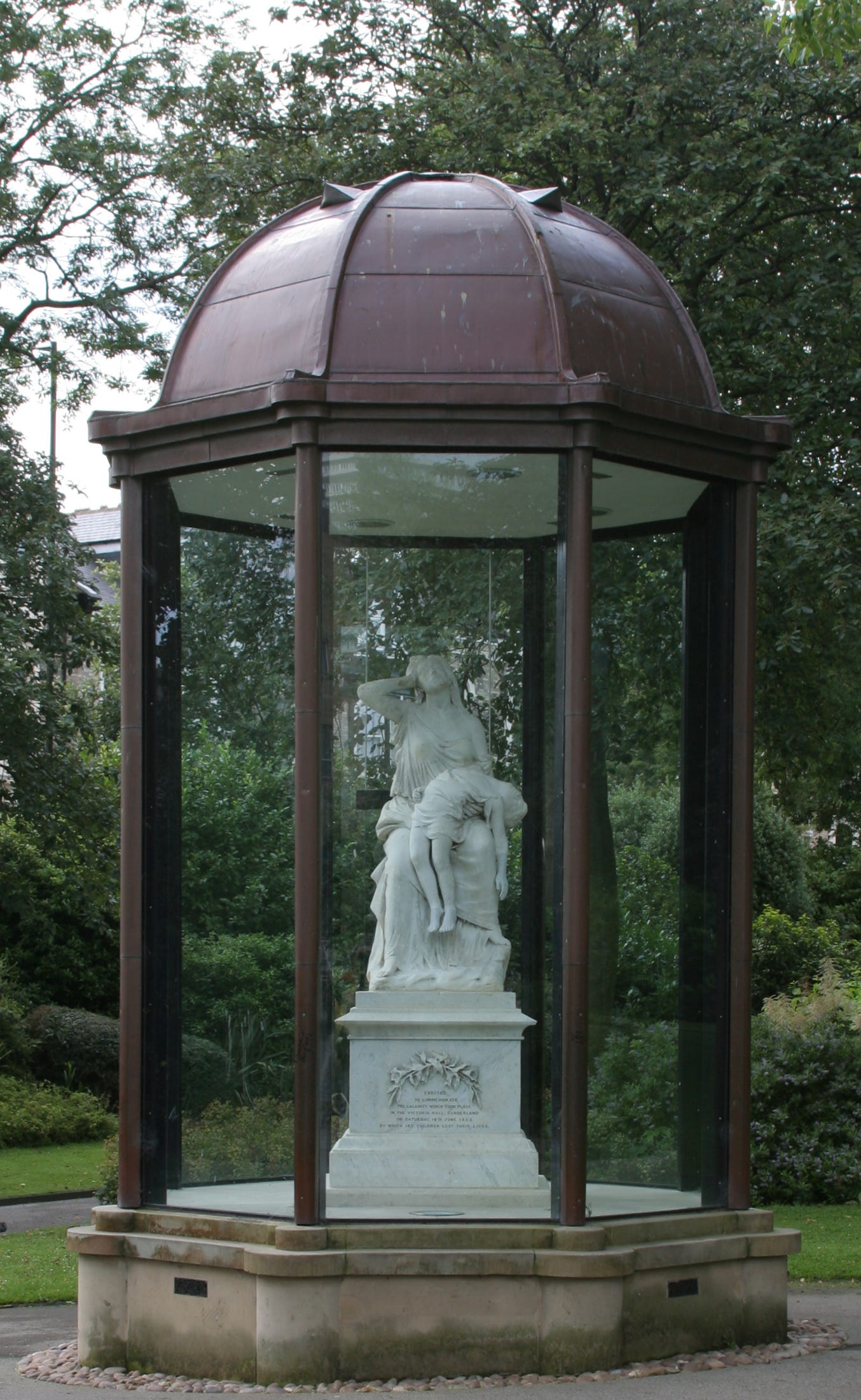
The inquest (an official hearing a coroner holds to work out how someone died, when a death is sudden or unnatural) recommended that “all doors, both internal or external, open outwards.” Today there’s a memorial in a park across from where the hall stood: a marble statue of a mother holding her dead child.

The panic bolt
Ok, so how do you make sure a door can always be opened from the inside? Today that sounds like a no-brainer, but back then a door was locked with a key or a bolt, and somebody had to be there to undo it. And theatres and halls had a good reason to keep their doors locked: people sneaking in without paying. At a theatre fire in Brooklyn in 1876, the side doors were normally kept locked to stop people getting in for free, and when the crowd got to one, it was locked with no usher in sight. Even the door in Sunderland was probably bolted half open on purpose, so the kids would come through one at a time and their ticket numbers could be checked.
So venues had a real problem: how do you keep people from getting in, while making sure everyone can always get out?
In 1892, a man called Robert Alexander Briggs got a British patent for “Bolts and Fastenings for Doors of Theatres and other Public Buildings.” You push a rod on the inside of the door, and it pulls back the bolts at the top and bottom, so the door swings open. He called it a panic bolt, and it was first fitted at a new theatre in Edinburgh later that year. One push opens it from the inside, while from the outside the door stays “absolutely secure from unauthorised entry.” Perfect. Jolly good, problem solved!
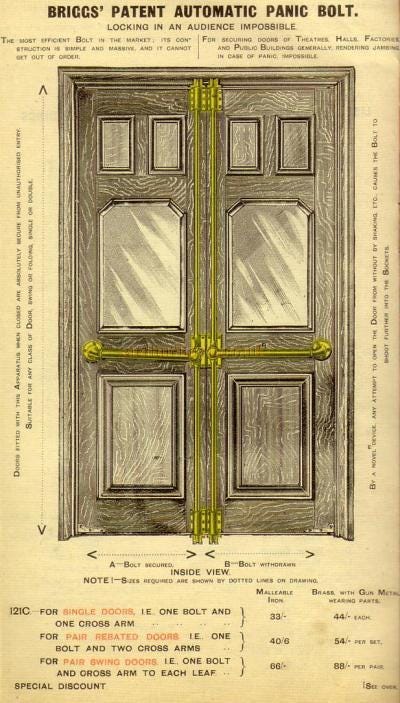
The family story goes that Briggs was so shocked by what happened in Sunderland that he decided it should never happen again, and eight years later he applied for the patent on the bolt he’d perfected.
A “fireproof” theatre in Chicago
Unfortunately, the lesson didn’t make it across the pond.
It was Wednesday, 30 December 1903, in Chicago. The weather was fair and freezing, with temperatures in the low teens Fahrenheit (around minus 10°C). The Iroquois Theatre, which had opened just five weeks earlier and been advertised as “absolutely fireproof,” was putting on a holiday afternoon show, and the audience was mostly women and children.
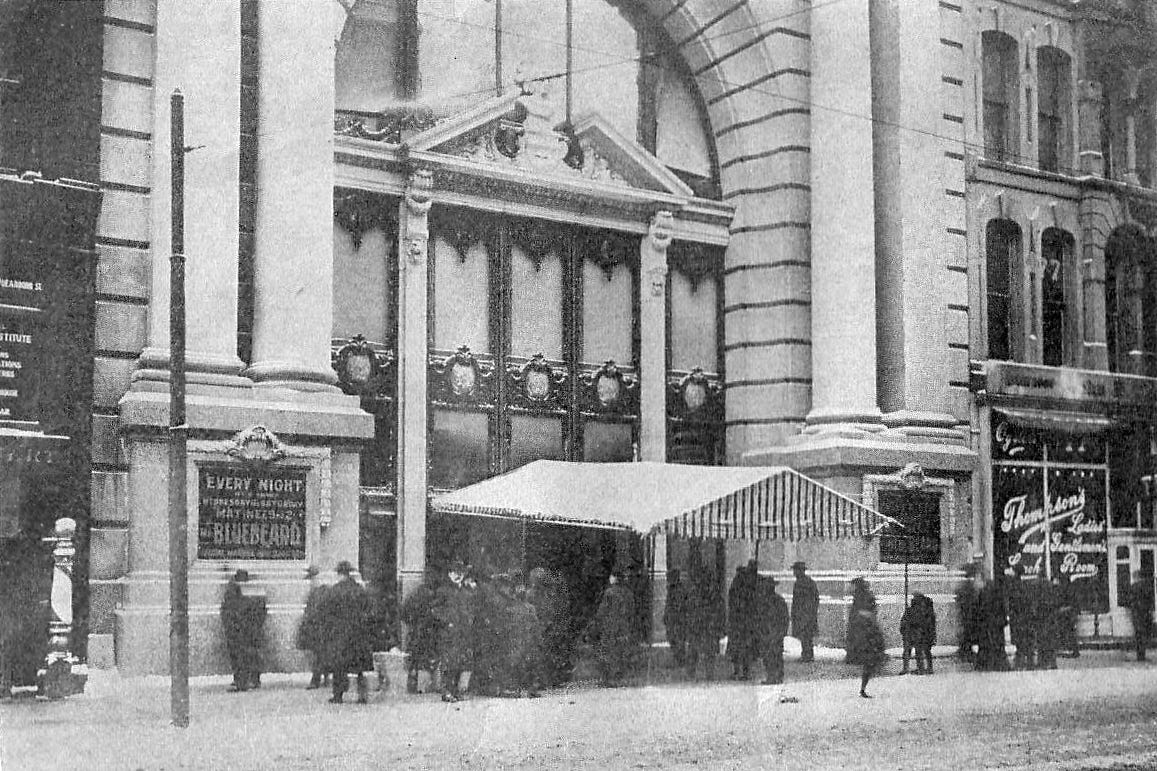

During the show, a stage light set the curtains on fire. And it turned out that fire safety just wasn’t much of a priority at the Iroquois:
Only one door at the main entrance was open. The others were locked, “according, it appears, to custom.”
Other doors were “either frozen or rusted” shut.
Some exits were hidden behind drapes.
Many doors had “bascule” locks, a European style of lock that most Americans had never seen and didn’t know how to open.
So people did what the kids in Sunderland did. They rushed the few doors that would open, and the crowd behind kept pushing. The Chicago Tribune wrote that “scores were wedged in the doorways, pinned by the force of those behind them” (dozens of people stuck in the doorways, held in place by the crowd pressing into them from behind). Bodies were found “six and seven feet deep.” Nearly 600 people died, most of them within about 15 minutes.
So, same as in Sunderland: in an emergency, people couldn’t get through the doors they were pushing against.
The salesman who skipped the show
Carl Prinzler was a manager at a hardware store in Indianapolis. The story goes that he was actually in Chicago on a sales trip, planned to catch a show at the Iroquois, and changed his plans at the last minute to head home.
When he heard what happened, he was angry at “the hardware men who stood by idly with no solution.” He’d noticed that people rushing for an exit “usually fall at the doors themselves, many piling up against the doors.” In his own words: “By that time we felt something MUST be done!”
So he teamed up with his neighbor, an architectural engineer, and they came up with a bar that runs across the door. The first one went on a door at an Indianapolis high school in 1908, five years after the Iroquois fire, and the patent came through the year after.
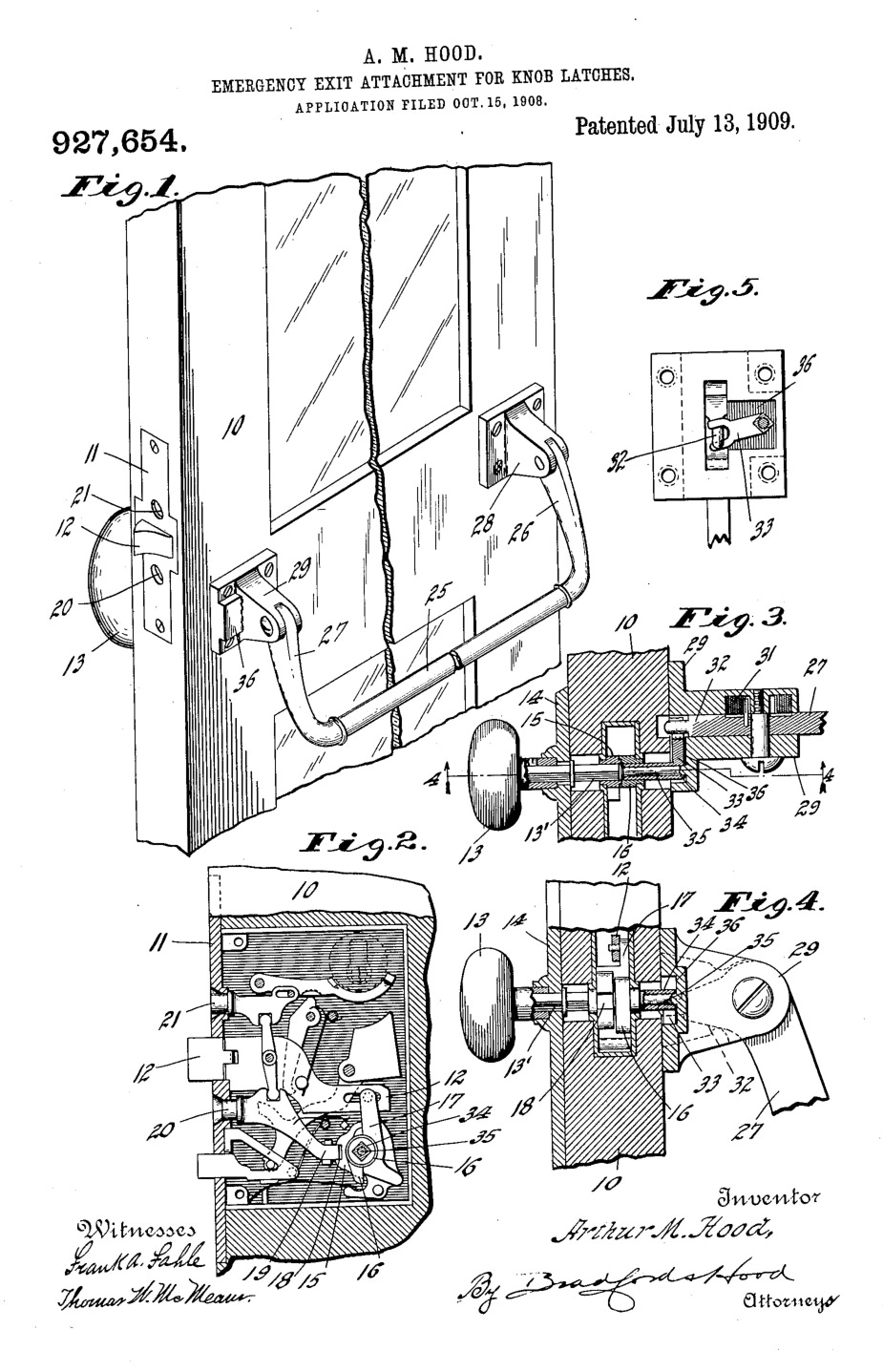
They started selling it in 1910. A year later, a fire broke out at another Indianapolis school, and every student got out within 45 seconds.
What I find interesting is that both of these stories come back to regular people who saw a tragedy and felt like they had to do something about it themselves: a young man in England and a hardware store manager in Indianapolis. It reminds me of this quote:
“Everything around you that you call life was made up by people that were no smarter than you.” - Steve Jobs
Old habits die hard
You’d think that would be the end of it, but it took a lot more disasters for the rules to catch on:
1911, New York: 146 garment workers died in the Triangle Shirtwaist Factory fire. The law already said factory doors should open outward “where practicable,” and the ninth floor stair door, the one workers couldn’t get open, didn’t.
1913: America’s fire safety association set up a Committee on Safety to Life, which said exit doors should swing the way people are escaping. Its work became the Life Safety Code that US buildings still follow today.
1929, Paisley, Scotland: 71 children died at a New Year’s Eve cinema show after a film canister started smoking. There wasn’t even a fire. The doors opened inward, and the bodies piled up behind them.
1942, Boston: 490 people died in the Cocoanut Grove nightclub fire. One exit actually had a panic lock, but it was “rendered useless” by a second lock next to it that was locked.
2006: the US building code tightened the rule. Theatres, schools and other rooms for 50 or more people now need panic bars, down from 100.
2024: Dollar General paid a $12 million settlement in the US over stock blocking emergency exits in its stores.
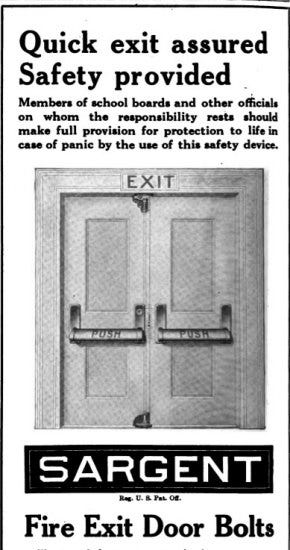

So when did all of this actually become law? There’s no single date, because it happened city by city. London required theatre doors to open outwards as early as 1879, and in February 1892, the same year Briggs got his patent, it ruled that exit doors could only be fastened with “automatic bolts,” the push-to-open kind. Funnily enough, Chicago already had a rule that theatre doors open outward before the Iroquois fire. Less than three weeks after the fire, the city added that exits couldn’t be hidden behind drapes or locked while a theatre was open. And by 1939, America’s national exit code said schools and theatres needed “fire exit bolts” that open with no more than 15 pounds of push.
Today, in the US, any room that holds 50 or more people needs doors that swing outward, and in the UK the cutoff is 60 people. The bar has to cover at least half the door, and it still has to open with no more than 15 pounds of push, the same number as back in 1939. Remember the 1,000+ pounds a crowd can push with? The bar only needs 15.
A door that tells you what to do
So how does it actually work? When you push anywhere along the bar, it pulls back the latch holding the door shut. The door opens to “any horizontal force on the bar.” You don’t need to grip or twist anything, or know how it works. Your hands, your hip, or someone falling against it all do the job.
What makes it such good design? Don Norman, who wrote The Design of Everyday Things (I wrote about it in good design is hard to notice), has a set of design principles, and the panic bar ticks pretty much every box. The Iroquois theatre in Chicago, on the other hand, failed a lot of them:
Discoverability (can you even figure out what actions are possible and where?): the bar runs across the door at waist height, so it’s hard to miss. At the Iroquois, some exits were hidden behind drapes. And at a nightclub fire in Rhode Island in 2003, three other exits were open and lit up, “but most people never realized they were there.” 100 people died.
Affordance (what an object lets you do with it): Norman says “a flat plate mounted on a door affords pushing.” And pushing is exactly what a crowd does anyway.
Signifier (the signal that tells you where to do the action): the bar is its own signal. You don’t need a sign telling you to push it. Norman says that when signs “have to be added to something as simple as a door, it indicates bad design.”
Mapping (how the thing you touch relates to what happens): you push toward the outside, and the door swings toward the outside, the same way you’re trying to go.
Feedback (letting you know your action worked, which I wrote about in how errors can lead to a positive experience): the door starts opening the moment you push, so you know straight away it’s working.
Conceptual model (a simple explanation in your head of how something works): you basically don’t need one. The European standard for panic bars says they have to work “without prior knowledge of operation.” The bascule locks at the Iroquois needed exactly the knowledge nobody had.
Constraints (limits on what you can do, so it’s hard to get wrong): the bar only moves one way, in. There’s nothing to twist, pull or figure out.
That said, it’s not perfect. The panic bar is great at one thing: opening when you push it. It has no plan B. If the latch gets stuck, or something is blocking the door from the other side, nothing tells you what to do next. Do you push harder? Pull and try again? Give up and look for another door? And you can’t see what’s on the other side until you’re already pushing against it. This isn’t just hypothetical either. Remember Dollar General and the stock blocking its exits? And at a nightclub fire in Brazil in 2013, security guards briefly blocked the only exit because they thought customers were running off without paying their bar tabs. The best door in the world can’t help if someone else decides it shouldn’t open.
A side note, and something ironic about the name: the people who study crowds say panic is mostly a myth. I’ve personally never been in a fire or a crowd crush, so I don’t have a first-hand account, but according to crowd science, panic is rare, and in emergencies people tend to help each other. Crowds become deadly because of pressure. When too many people are packed into too small a space, they physically can’t control where they move anymore, and people die from being squeezed until they can’t breathe, not from being trampled. Or as one crowd scientist put it: “People don’t die because they panic. They panic because they are dying.”
So the next time you push open one of those doors, maybe take a moment to think about the people who lost their lives simply because this wasn’t a thing when they needed it. I know I will.