

I honestly can’t remember the last time I paid for something with cash. Everything is done through Apple Pay / tap to pay. The last 5 years I was in Canada and I didn’t even carry my wallet. Just my phone and one of those metal card holders to carry my ID. I’m currently in Dubai and I must admit that there is a culture of tipping in cash, and thus I do have to carry my wallet with the correct cash denominations (obtaining these is at times a mission in itself).
But I recently learned about a few times when a new coin design created an uproar. It seems kind of silly in 2026, as the use of physical cash in most parts of the world continues to diminish. In the UK, cash was 8% of all payments in 2025, down from 45% in 2015. In the US, it was 14% of payments in 2024. And here in the UAE, Dubai launched a strategy targeting 90% cashless transactions. And so to get a better understanding, we’ve got to take a trip back in history.
Why bother?
So you might be wondering, as I was, why do countries create new coins? Out of all the things a government could be working on, they spend their resources on designing and producing a new coin?? Things seemed to be fine before the coin was launched, so why bother??? Are they just creating a fancy new design to one up or show off to other countries????
Well, the reasons are quite interesting. One of the common ones being money. Let me explain.
As weird as it may sound, money costs money to make. And so like anything that costs money, it too is analyzed from a financial point of view. For instance, in 1978 the US worked out that a $1 coin would cost 3 cents to make and last at least 15 years, while the $1 note cost 1.8 cents but lasted only about 18 months. Similarly, the UK ten-shilling note (ten shillings was half a pound, so 50p in today’s money) lasted four to five months in the 1960s, which is why the 50p coin replaced it in 1969. That coin is still in use today, more than 55 years later.
Inflation is another key driver. The US Treasury said higher-value coins were “the consequence rather than the cause of the general inflationary trend.” If things are getting more expensive, you don’t want to be carrying around more and more coins. Higher value coins made things easier for both customers and businesses.
Some other, rather surprising, reasons are vending machines and counterfeits.
Imagine your invention becomes so popular that the government has to create a new coin to meet demand. Now that’s a story I’d like to tell my grandchildren. The US Mint said a $1 coin would let vending offer “a whole range of items not now available,” and the Royal Mint (UK) cites “the growing vending industry” for the pound coin.
The longer the coin is out there, the more time bad actors have to make counterfeits. As recently as 2014, 1 in 30 UK pound coins was fake. That’s yet another reason to create a new coin, and send the bad actors rushing back to their labs.

Let’s now talk about specific instances when a new coin didn’t go quite as planned.
🇫🇷 1986: Trouble in Paris
Ok, let’s start with my favorite one. We’re going to France, in the autumn of 1986.
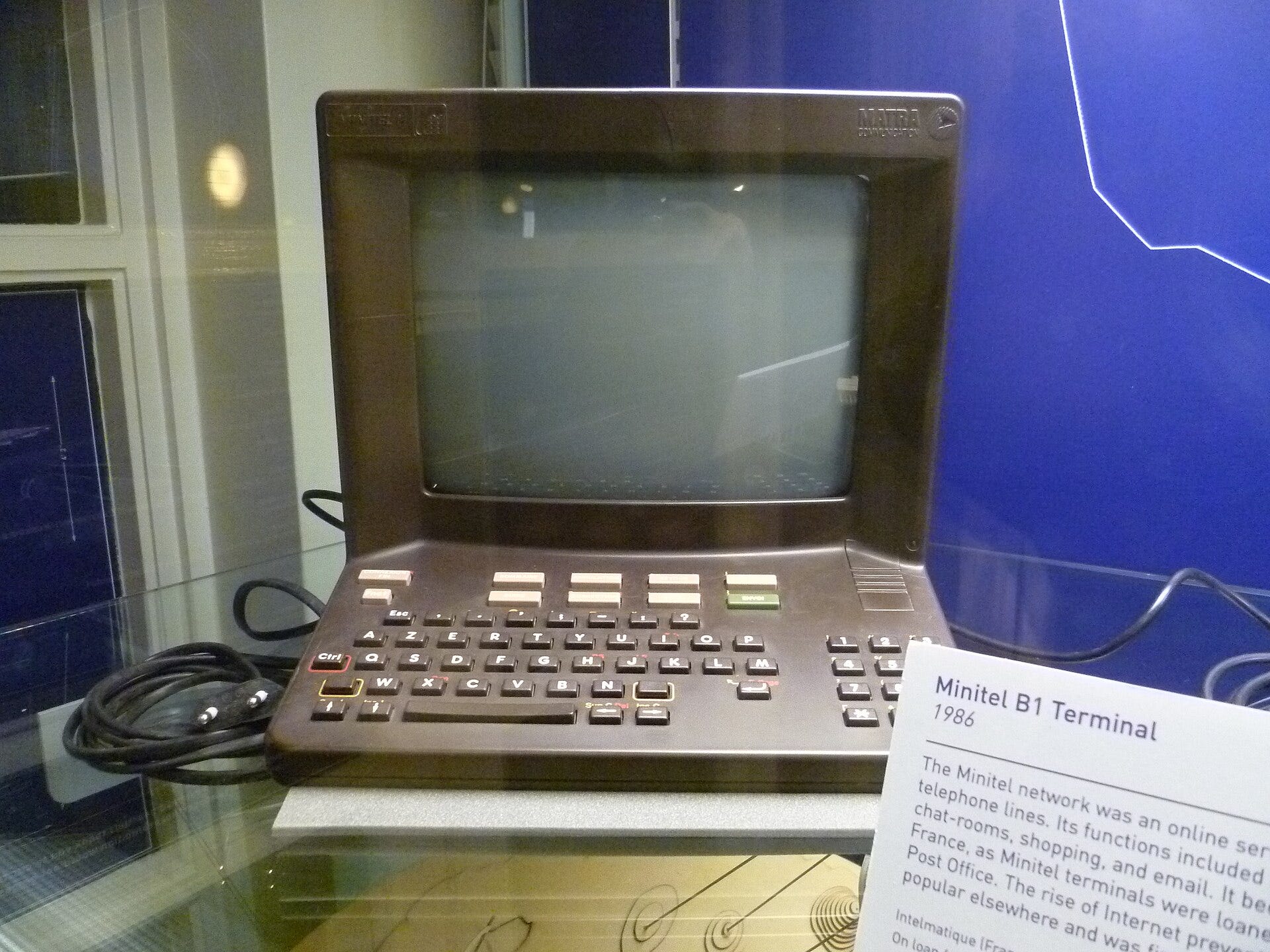
Jacques Chirac had become prime minister that spring, and his finance minister was Édouard Balladur (remember that name). Card payments were still pretty new: only about 5.6 million French people had a bank card, in a country of about 56 million. A 10 franc coin would get you about three coffees at a café, which is about €3 or $3.50 in today’s money. And instead of the internet, there was the Minitel, a little screen and keyboard that plugged into your phone line, with about 1.4 million in use.
A quick bit of context on French money, because it confused me at first. Like the dollar, the franc was decimal: 100 centimes made one franc. So the ½ franc coin, which everyone called “the 50 centimes,” was half a franc, and a 10 franc coin was worth 20 of them (two ½ francs make one franc, so ten francs is 20 of them).
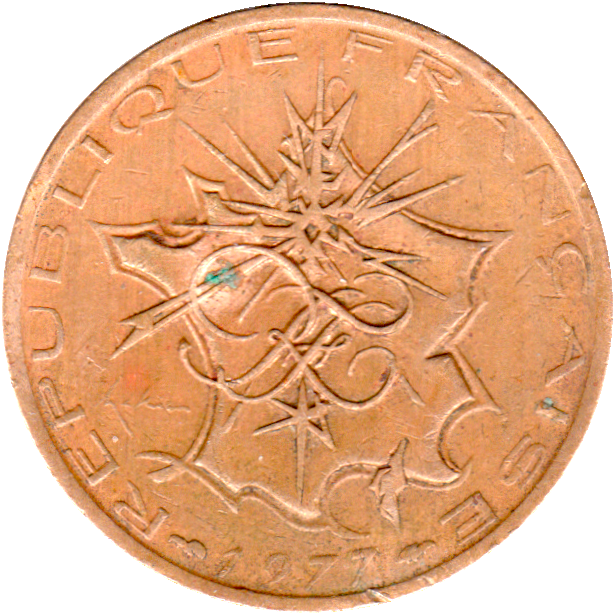
France already had a 10 franc coin from 1974, designed by the painter Georges Mathieu, and people liked it. But a 1985 Senate report said counterfeiting it was “easy and on a large scale,” so the government decided to replace it.
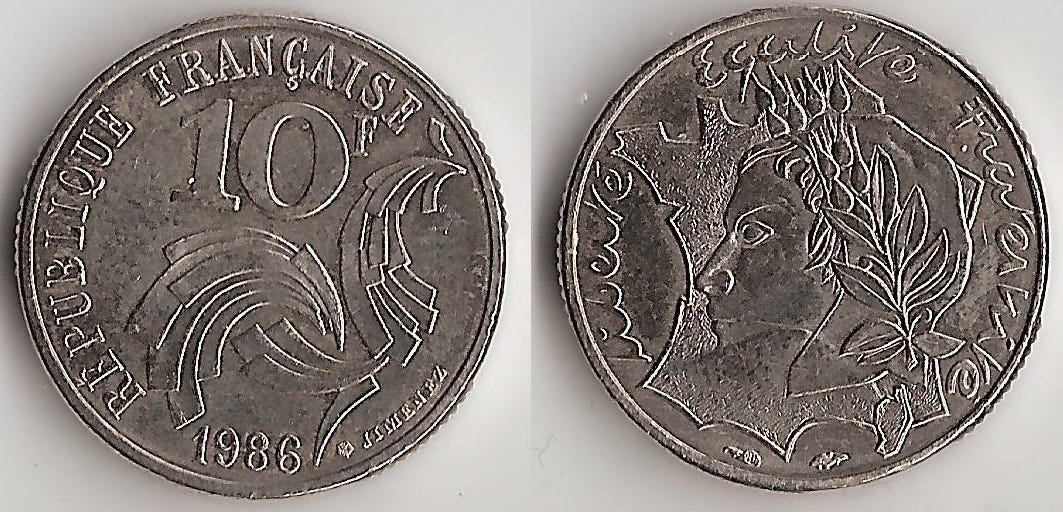
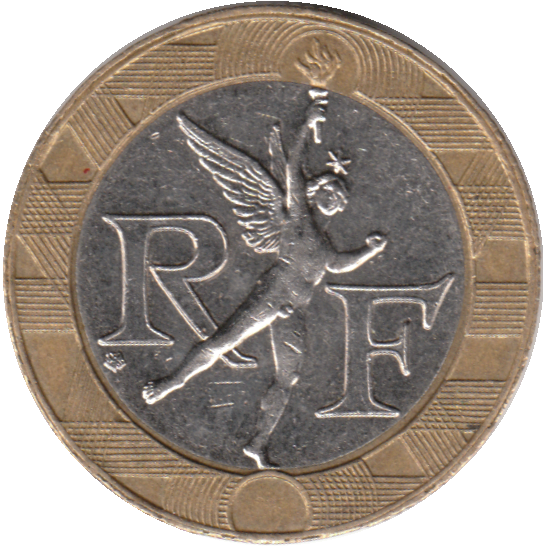
The new coin, designed by Joaquin Jimenez, was pure nickel, 21 mm across and 6.5 g, with an edge split into five smooth and five ridged sections, which the Senate said “will make it easier for blind people to use.” The size wasn’t up to the artist, though. A working group of professionals and users set the specs.
The problem was the ½ franc already in everyone’s pocket. It was also silver-colored nickel, 19.5 mm across, with a ridged edge. So the new 10 francs was only 1.5 mm wider than a coin worth twenty times less. And the 1 franc coin (24 mm) was bigger than both.
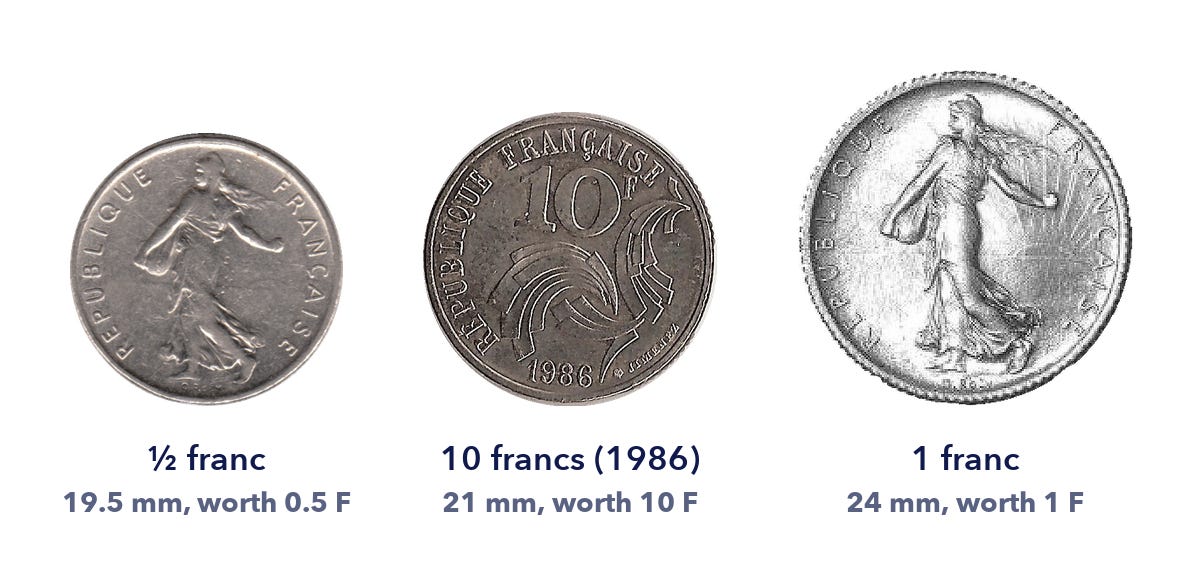
Two design principles got messed up here. The first is mapping (how well something’s layout matches what it does; I wrote about it in an earlier issue). We expect a bigger coin to be worth more, and one French member of parliament even pointed to an unwritten rule, in place since the 1720s, that coins get bigger as their value goes up. The second is feedback (what something tells you back when you use it). A coin’s size, color and feel should tell you what you’re holding, and another member of parliament said the two were hard to tell apart “by sight as well as by touch.”

And then the drama. Within weeks, members of parliament from the far right all the way to the Socialists were complaining about the elderly, children and shopkeepers mixing them up. On 23 November, Balladur defended the coin in the Senate:
“With a minimum of habit, confusing it with that coin will no longer be possible. In any case, it is too late.” - Édouard Balladur, 23 November 1986
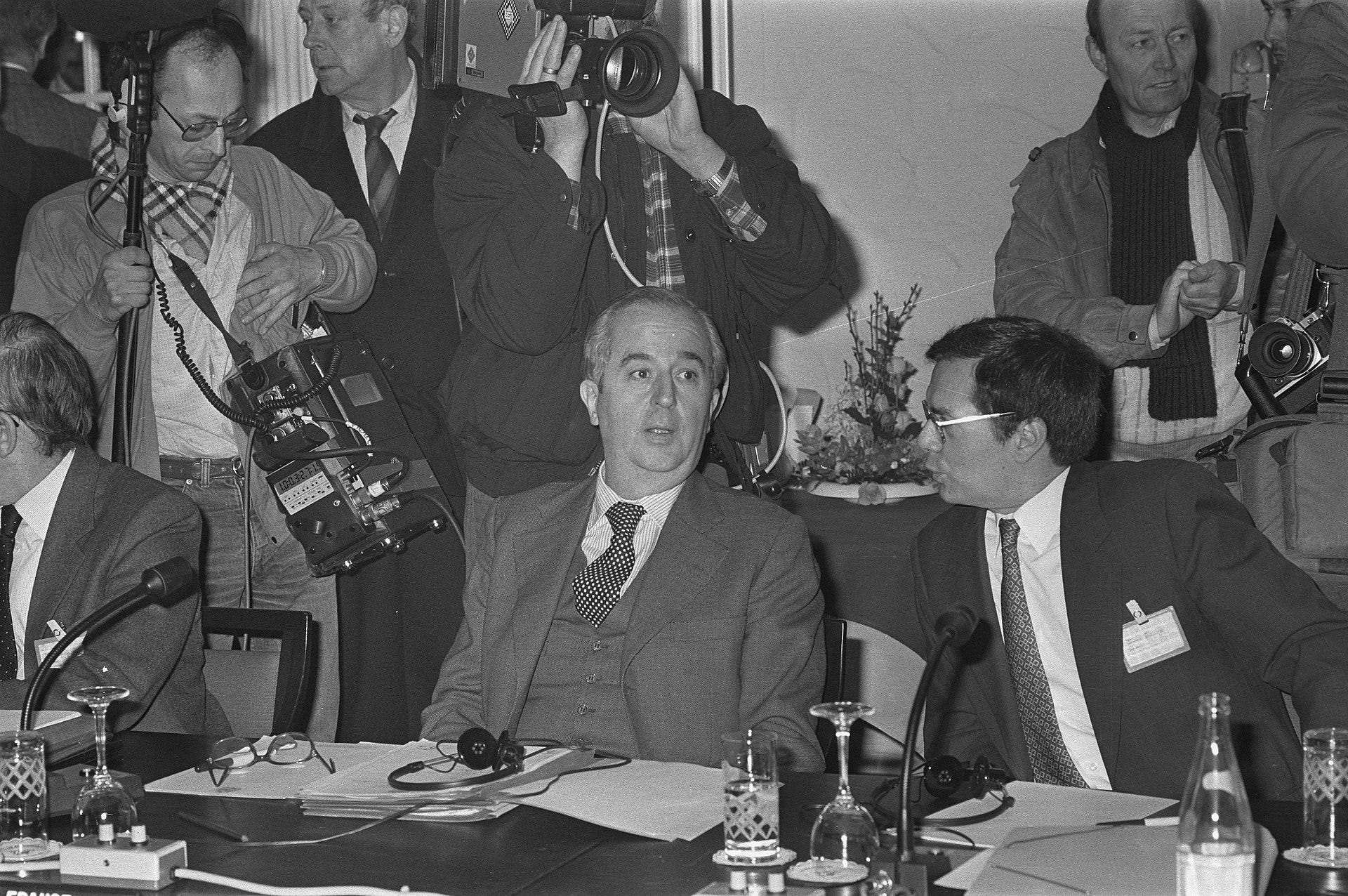
Four days later, he suspended it!

Can you imagine the internal debate and turmoil that led him to make that call? All the money spent on the design, the metal and the production, out the window. Why isn’t there a Netflix documentary on this?
And the French press were ruthless lol. Two days after that, Le Monde, one of France’s biggest newspapers, ran a story headlined “T’as pas 10 balles?” (slang for “Got 10 francs on you?”). It said people were losing 9.50 francs at a time while buying bread or a newspaper, and added:
“Launched with a press blitz like a bar of soap, it slid, by way of the media, into the hell of popular vengeance.” - Le Monde, 29 November 1986
On 20 December, Balladur announced the coin would be withdrawn for good, and people had until 30 June 1987 to swap theirs. It’s the only coin in this story that was actually pulled back out of people’s pockets. Only 22.58 million ever reached the public, and getting them back cost 100 million francs (about $15 million at the time). Two years later, France tried again with a two-colored 10 francs, which was “well accepted by the public.”
🇺🇸 🇬🇧 1979 and 1983: Swapping notes for coins
Next up, America and Britain. These two have a lot in common: they speak the same language (mostly), they had a little falling out in 1776, they still can’t agree on how to spell “color,” and oh yeah, both were turning their smallest note into a coin.
Let’s start with the US. By the late 1970s, the $1 bill made up 60% of all US currency printed, and each one wore out in about 18 months. There was already a dollar coin, but it was huge, and the Mint itself admitted it “has not become a useful part of our coinage system.” So in 1978 Congress approved a smaller one, with Susan B. Anthony, who campaigned for women’s right to vote, on the front. The $1 note stayed, though.
A lot of its design came from the machines. Its weight and size were set with the makers of coin-handling equipment. The Mint tested an 11-sided coin, but went round for “technical considerations.” It tried gold-colored metals, but they turned “various shades of yellow-green”, so it went silver. And it got a ridged edge to stop counterfeits.
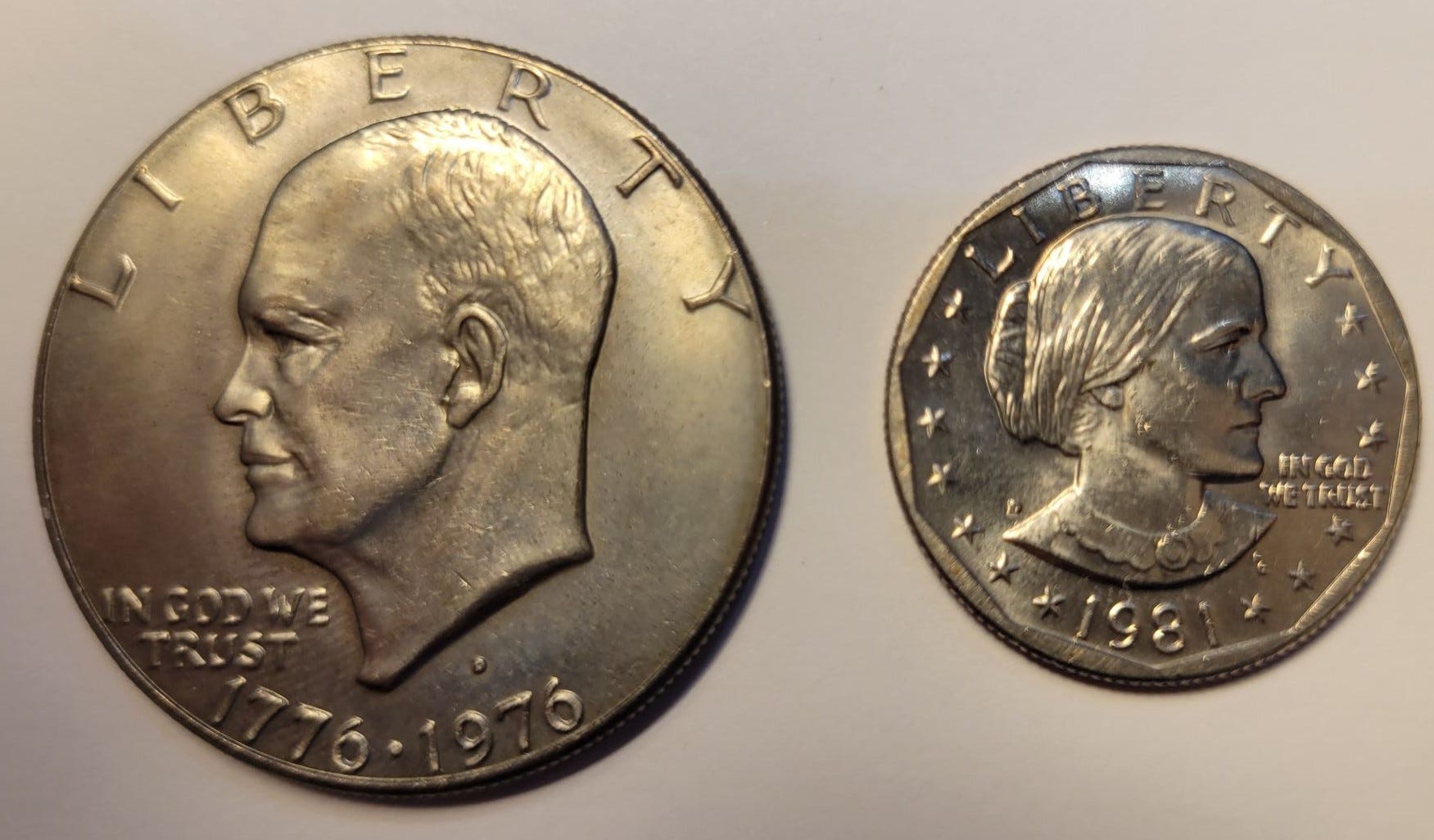
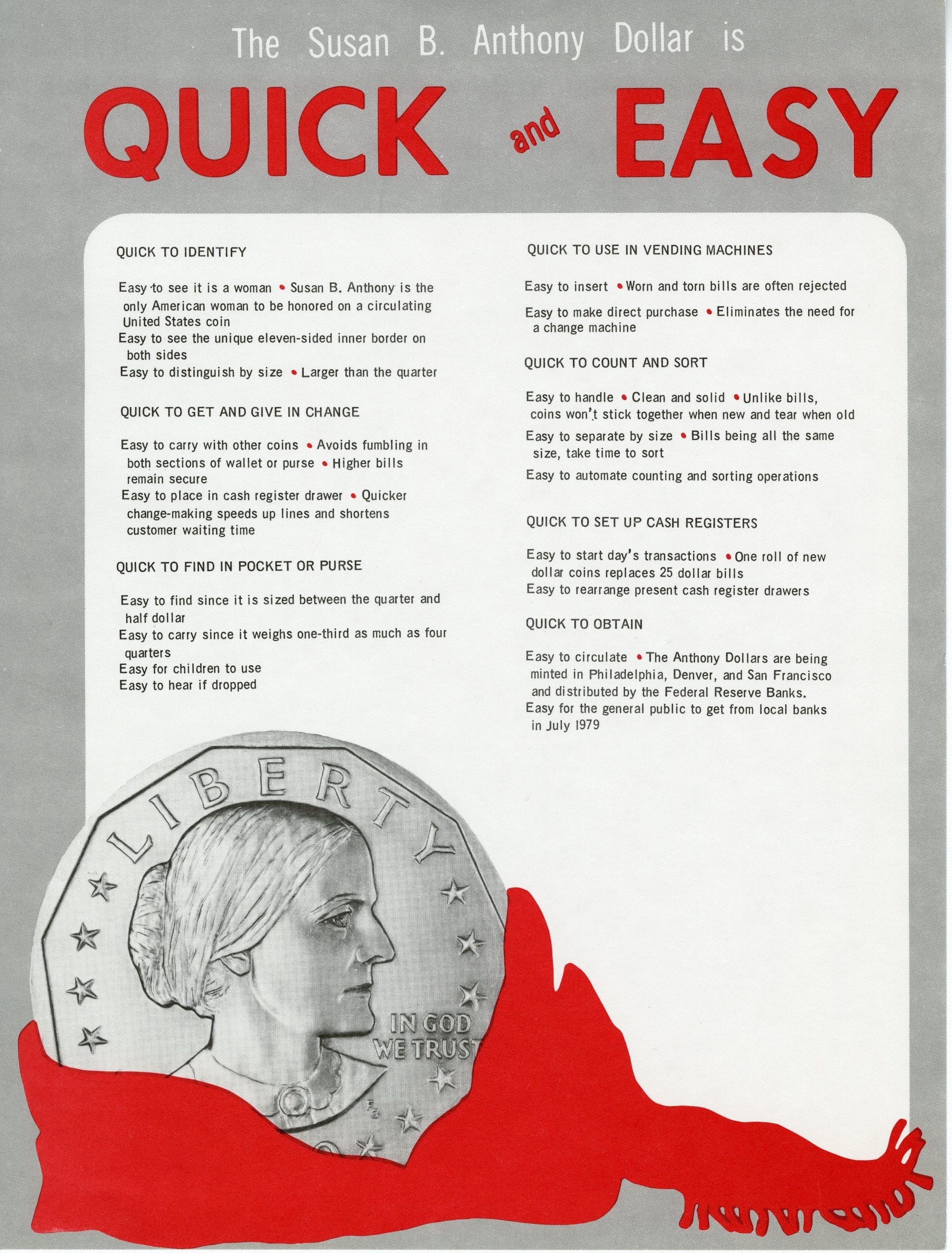
The result was a coin with the same color, edge and shape as the quarter, and only 2.24 mm wider. Focus groups run for the Federal Reserve had flagged its “perceived similarity to the quarter” a year before launch. Meanwhile, the Treasury’s own flyer promised it was “easy to distinguish by size”. Take a look below.
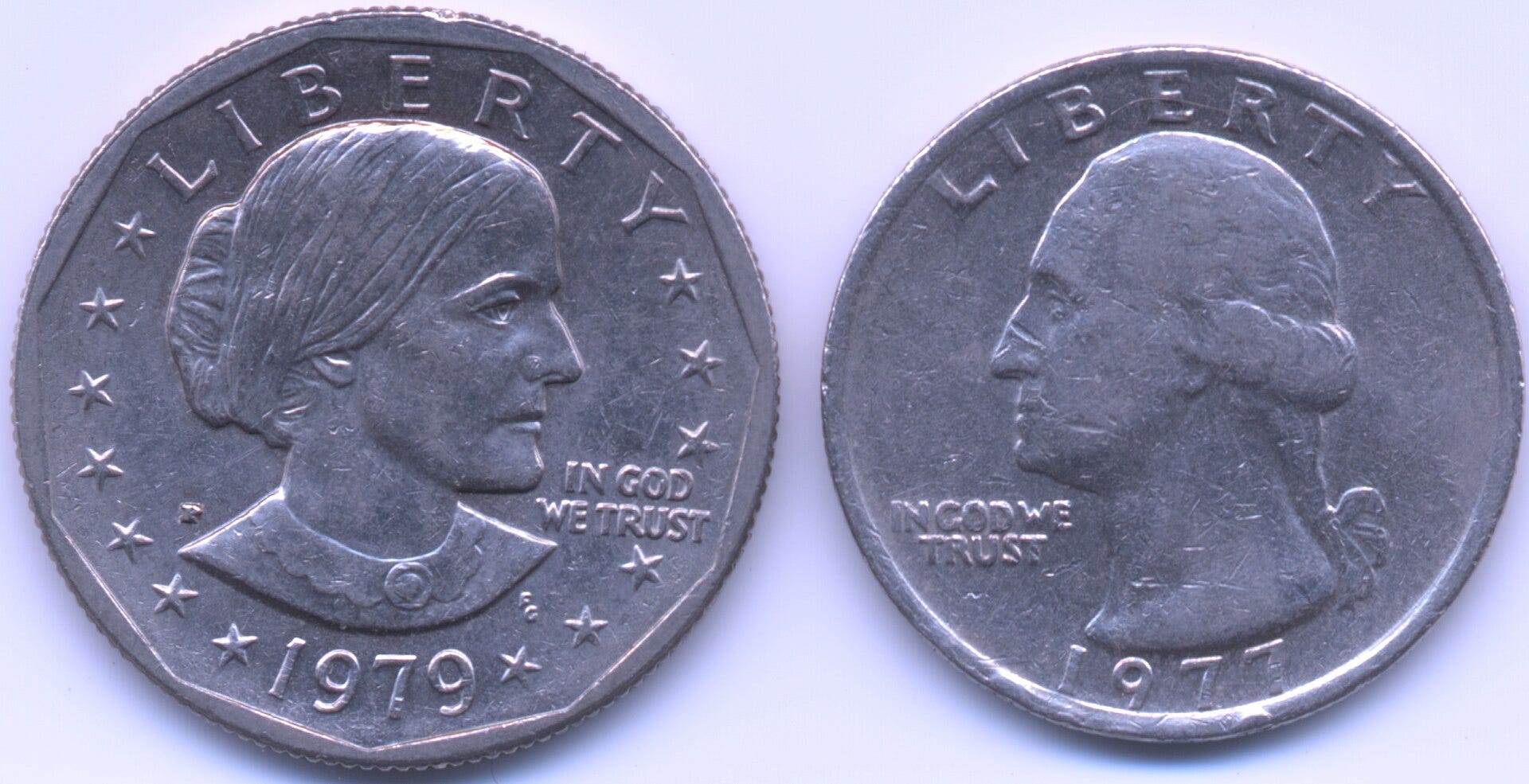
It came out in July 1979, and the confusion started on day one. Restaurant customers left them as tips with notes saying “These are not quarters.” In Providence, a store clerk turned one down, thinking it was a Canadian quarter. By October, 66% of Americans disliked it, mostly because it looked like a quarter. People just weren’t using it. The Mint stopped making them for everyday use in early 1980, less than a year after launch, and by that August, only 300 million of the 800 million made were in circulation. In 1981, there were still 520 million of them sitting in storage.
That’s feedback again: in your hand, the dollar gave you the same answer as a quarter. And with the $1 note still around, nobody had a reason to get used to it.
Britain did it a different way. In 1983, it brought in a £1 coin (about $1.52 at the time) to replace the £1 note. It was gold-colored, so it stood out from the silver coins, but it was only 22.5 mm across, smaller than coins worth far less, like the 10p and the 50p.
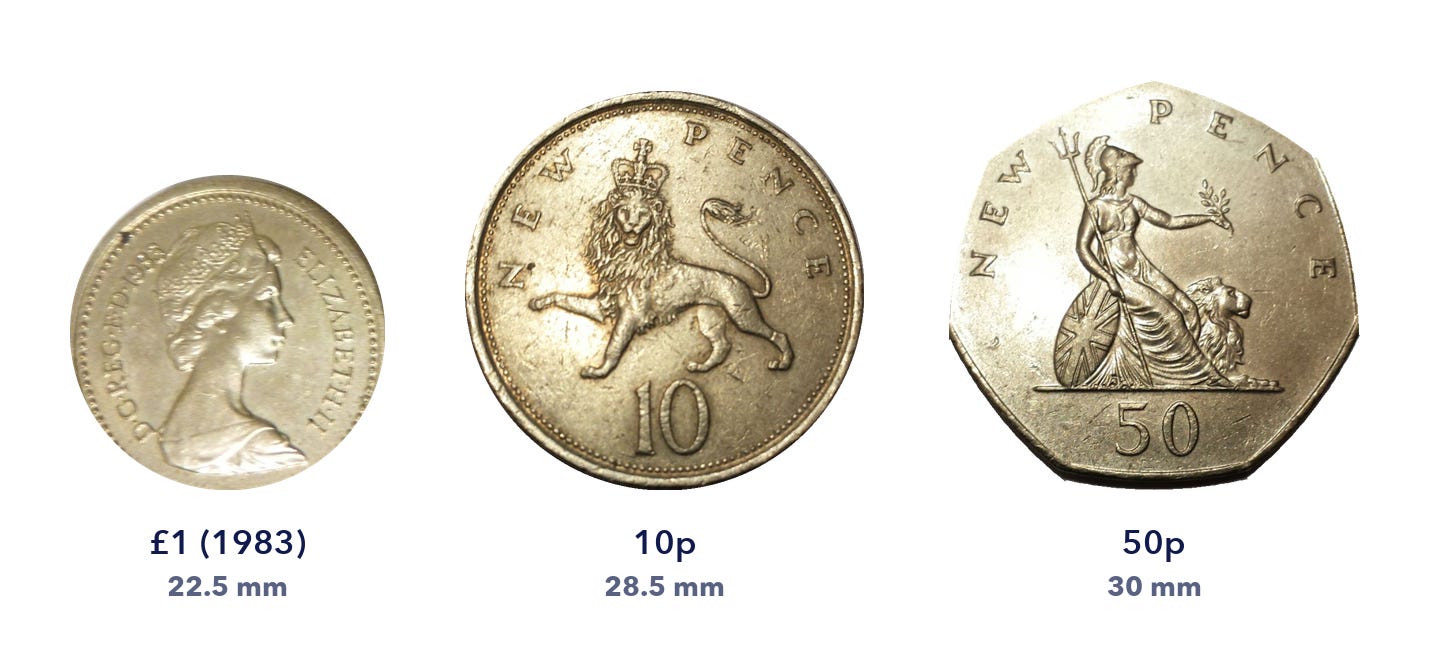
That’s mapping again. People in London called it “Too small” and “Like toy money,” and in the House of Lords, one member asked “where this strange ‘Noddy’ money was created, and who thought of it?” (Noddy is a little wooden toy from British children’s books.) Even Margaret Thatcher’s own adviser wrote to her that “the pound coin remains highly unpopular.”
The government withdrew the note anyway (it stopped being legal tender in 1988), and with no note to fall back on, “public dissatisfaction dissipated within a few years.” And that’s the big difference from the US, which never stopped printing its $1 note.
🇯🇵 🇰🇷 1982: Japan vs Korea
Ok, last one, and this time the trouble came from another country. In 1982, Japan launched a 500 yen coin. And somehow that same year, South Korea launched a 500 won coin with the same diameter and the same metal, but worth only about a third as much (around $0.68 against $2.01 at the time). By 1999, the won coin was worth about a tenth of the yen coin (around $0.42 against $4.40).
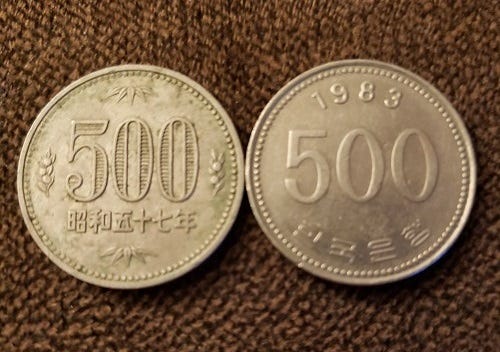
So people drilled or shaved won coins until they matched the yen coin’s weight, put them into a vending machine, and pressed the refund lever. The machine then gave them back a real 500 yen coin.



And Japan has a LOT of vending machines, about 5.5 million of them at the time.
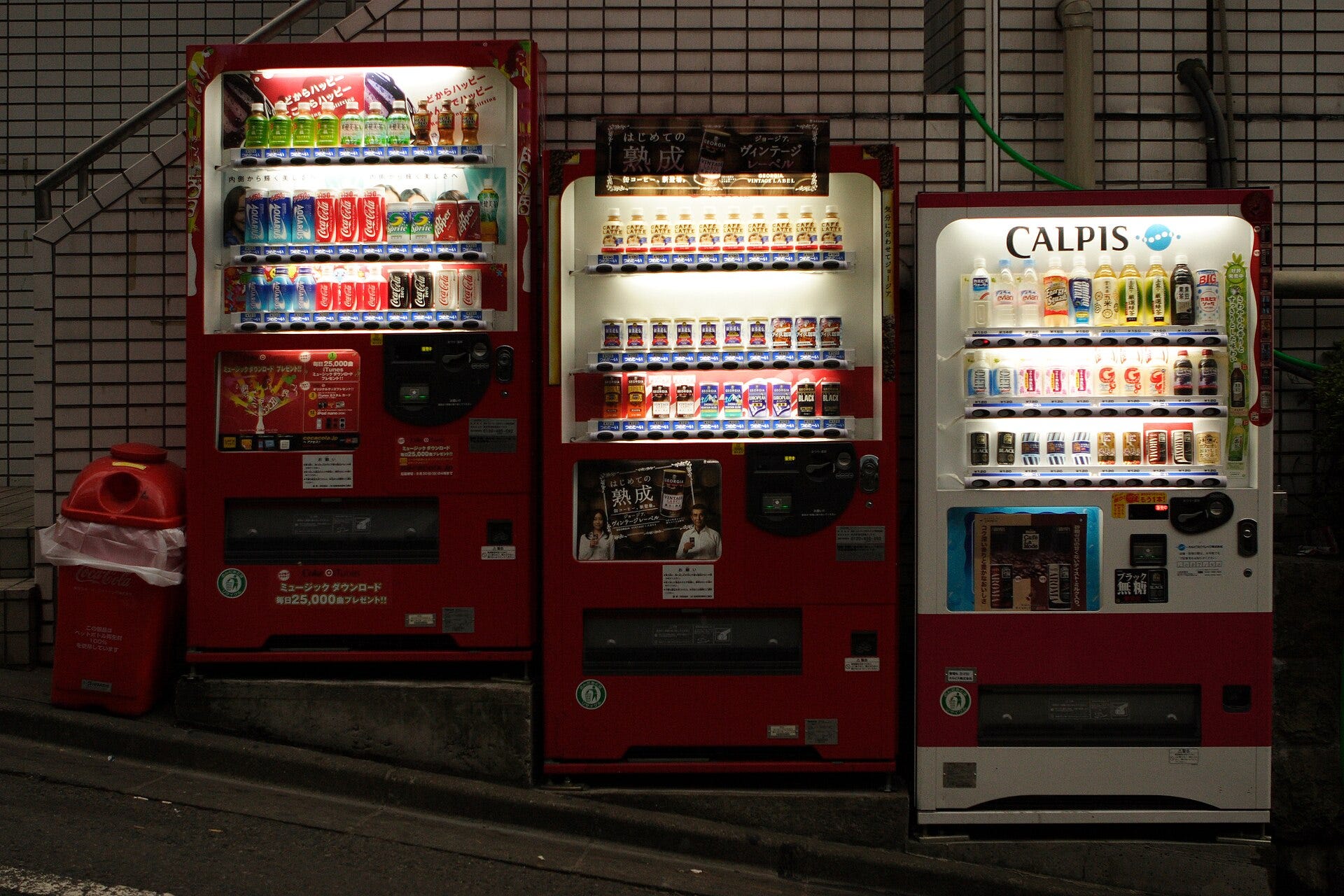

In 1999, police found 657,000 altered coins in ten months, and about 70% of Japan’s vending machines stopped taking 500 yen coins altogether.
In this case, the confused user was the machine. Vending machines identify a coin by its size, weight and metal, and on all three, the won and the yen gave the same answer. So the fix, in 2000, kept the coin’s look and changed its metal. And it still happens today: in 2025, an udon shop owner in Tokyo said he’d been paid with 500 won coins nearly 15 times in 10 years.
Seeing the patterns
So what do these stories have in common? First, machines shape coins a lot more than I expected. The Anthony dollar’s size and weight came from the machine makers, and when Europe designed the euro, blind campaigners asked for a multi-sided coin and lost after the vending machine industry “fiercely opposed” it.
Second, we don’t really look at our coins. We notice just enough to tell them apart, like the size, the color and maybe the edge. So when a new coin looks and feels like one we already have, it’s really easy to mix them up.
The three design principles that kept coming up (I wrote about all three in an earlier issue):
Mapping (how well something’s layout matches what it does). We expect a bigger coin to be worth more. The French 10 francs and the British pound were both smaller than coins worth less.
Conceptual model (the picture in your head of how something works). If bigger means more valuable in your head, a small coin worth a lot doesn’t fit.
Feedback (what something tells you back when you use it). A coin’s color, size, weight and edge tell you what you’re holding. The Anthony dollar felt like a quarter, and the French 10 francs felt like the ½ franc.
Thatcher’s adviser put it best, back in 1983 (a “row” is British for a heated argument):
“All rows about new coins are much more heated and last much longer than the authorities expect.” - Ferdinand Mount to Margaret Thatcher, 25 November 1983
And funnily enough, there’s a story about the UAE too. In 2018, drivers in Abu Dhabi worked out that a Philippine 1 peso coin, worth about 12 times less, works in parking meters, because it’s almost the same size as the 1 dirham coin. One of them told Gulf News: “Now I do it often.” So maybe I should be checking the coins in my wallet a bit more closely...